
"Alas, Our Canals will Pass through Every Vale"
Freemasons and the American Canal System
Recognizing that if our novice country was ever to overcome these obstacles and truly harness the potential of its natural resources, Brother George Washington believed that accessible routes and improved modes of transportation would need to be developed. With this thought in mind, Brother Washington began toying with the idea of internal navigation. Up until this time in history, the proliferation of trade and commerce was limited geographically to the port cities that sprouted along the protected harbors of North America’s coastline. Tall Sailing Ships were the primary movers of the day before the advent of the Railroad Industry.

Although Brother Washington had a slight bias in favor of his home state of Virginia, Dorothie Bobbé writes in her book, De Witt Clinton, that Brother Washington charged his constituency saying that should “they not act, and quickly, New York and Pennsylvania would assuredly combine to acquire a monopoly of the western commerce, which it would be hard to wrest from them later”. Yet, always the statesman with the broader vision, Brother Washington’s foresight and scope of understanding is revealed when he wrote “I am not for discouraging the exertion of any State to draw the commerce of the Western country to its seaports. The more communication we open to it, the closer we bind that rising world… for indeed it may be so called… to our interests, and the greater strength we shall acquire by it. Those to whom nature affords the best communication will, if they are wise, enjoy the greatest share of the trade. All I would be understood to mean is that the gifts of providence may not be neglected.”
Regretfully, Brother Washington did not live long enough to see his vision come to fruition, as the building of the Potomac Canal Project did not actually commence as a full-scale operation until 1829. However, before the canal could be built, Brother Washington needed to establish a clear and navigable passageway from the headwaters of the Potomac River to its mouth.
To accomplish this immense task, Brother Washington engaged the engineering services of James Rumsey, the proprietor of the Liberty Pole and Flag Inn residing in Bath, Virginia. Today, the village of Bath is found in West Virginia. In Washington’s time, Bath had been the Mecca of the sophisticated gentry where they were inclined to vacation and convalesced and bathe in its famed healing waters. Brother Washington was known to have visited the area frequently when traveling to inspect his land-holdings in western Pennsylvania and Virginia.
James Rumsey amazed the scientific community of his day when he succeeded in building a series of locks that allowed a barge to avoid the Great Falls on the Potomac River by descending a distance of 76 feet in 1,250 yards. All of the undergrowth, weeds, earth, stone and rock had to be removed and cleared by hand using old fashioned plows, picks and shovels together with wheelbarrows and horse-drawn wagons.

Alvin F. Harlow states in his book, Old Towpaths, that James Rumsey reportedly described to Brother Washington how two men working with black powder were lost, “One run off, the other blown up; we therefore was Obliged to have two new Hands put to Blowing (i.e. blasting) and there was much attention gave to them least Axedents [sic] should happen”.
Primarily, the Chesapeake and Ohio Canal was used to transport coal-laden barges to Washington, D.C. During the canal’s heyday, some 800 plus canal boats were engaged in this enterprise carrying approximately 120 tons of the “black gold” cargo apiece. Each canal boat was equipped with a small bunkhouse for the captain and his family and a stable for two mules. The mules worked alternating six-hour shifts, with one mule pulling the barge while the other rested in the stable.
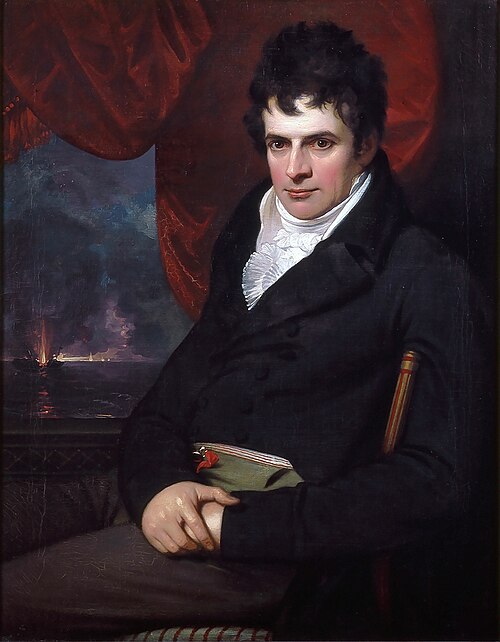
Bro. Robert Fulton
(November 14, 1765 – February 24, 1815)
One of the problems that “Brother” Fulton had to overcome was the excessive consumption of water that would undoubtedly occur on extremely steep inclines. To resolve this dilemma, “Brother” Fulton proposed installing coasters or small wheels on the bottom of each boat, thereby alleviating the drag caused by the boat’s bottom rubbing against the inclined plane and at the same time increasing the speed at which the canal boat would climb the ramp.
After reviewing “Brother” Fulton’s canal treatise, Brother Washington, as President forwarded the publication to Tobias Lear, his secretary at Mount Vernon. According to John C. Fitzpatrick in his book The Writings of George Washington, the following note accompanied the said publication, “If the Potomac Company can extract anything from it, I shall feel happy in having sent it to you”. A month after not having received any response thereto, Brother Washington inquired about Mr. Lear’s opinion of “Brother” Robert Fulton’s canal treatise. Unfortunately, no further records can be found pertaining to this discourse.
On the other hand, “Brother” Fulton’s treatise did not go entirely unheeded. Apparently a successful canal system incorporating the combined use of inclined planes and locks through the Appalachian Mountains connecting Philadelphia with Pittsburgh was built during the middle of the nineteenth century. Not too coincidentally, “Brother” Fulton states in his canal treatise that “I will suppose a canal from Philadelphia to Fort Pit or any other long line.” He also suggested that the government should regulate and control the use of such transportation systems, which in time fell under the State of Pennsylvania’s control and authority.
“Brother” Robert Fulton, the American inventor, has often been referred to as having held membership in the Masonic fraternity, but no actual Lodge record substantiating this claim has ever been found. However, it has been firmly established that “Brother” Robert Fulton maintained many notable Masons within his close circle of friends. Such famous Masons as Brothers De Witt Clinton and Chancellor Robert R Livingston who had befriended and entered into joint business ventures with the enterprising “Brother” Robert Fulton.

Image provided by David R. Arce
References to “Brother” Robert Fulton’s affiliation with the Craft can be found in the American Masonic Record periodical dated November 7, 1829; the first volume of The Craftsman, published on December 1, 1829; the September 1868 issue of The Kentucky Freemason publication; The History of Freemasonry in New York, written by McClenachan (vol. II, pg. 29); and the November 1971 issue of The Masonic Philatelist publication. McClenachan states in his book on Masonic history, that “Brother” Robert Fulton was a member of Hiram Lodge in New York City. Hiram Lodge No. 148 was warranted under the Phillips Grand Lodge of New York at the time of “Brother” Robert Fulton’s majority. The Lodge was granted a new warrant and assigned the number 449 on August 4, 1858 after the fraternal union of New York Grand Lodges was enacted. In recent times, Manahatta Lodge No. 489 consolidated with Hiram Lodge No. 449 and became known today as Manahatta Lodge No. 449 in the Fourth Manhattan District.
Writing also under a pseudonym, Brother De Witt Clinton published an essay by the penname Tacitus on the Canal Policy of the State of New York, where he joins with Hawley’s line of thinking and states that “To an intelligent and observing mind, the physiognomy of the country west of Rome to Lake Erie must present great facilities for artificial navigation. The abundant supply of water from the intermediate lakes, rivers, springs and creeks… the general and gradual ascent to the west… and the wide valleys through which canals might pass, are too obvious not to strike the observation of any traveler.”
At this point in his political career, Brother Clinton held the dual role of Mayor of the City of New York and State Senator. Eventually he would go on to become Lieutenant Governor of New York State and a viable Candidate for U.S. President from the Republican Party (not to be confused with today’s GOP). Brother Clinton lost the later election to James Madison due in part to a backlash generated by his opponents to the proposed canal project.
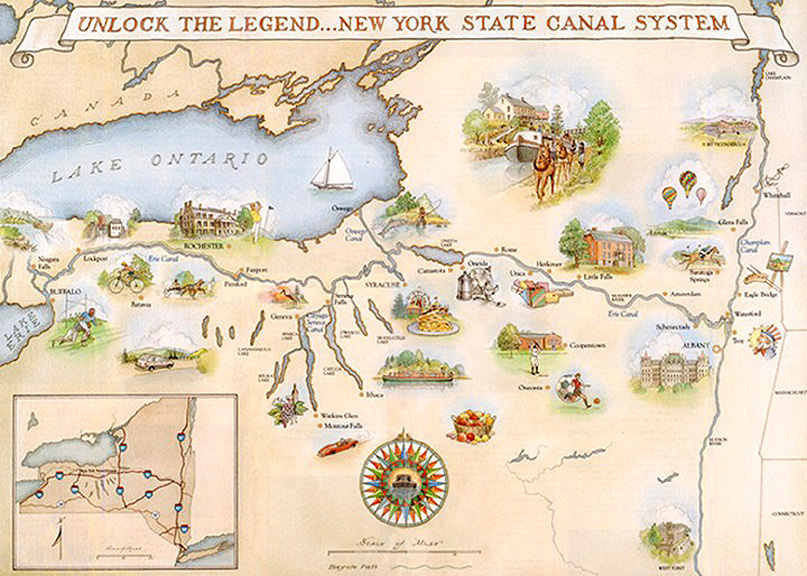
In spite of mounting odds, Brother Clinton together with the support of the party leadership was able to get legislation passed to establish a commission to study and survey the feasibility of building an artificial canal across the western part of New York State. This new commission known as the Board of Canal Commissioners included Gouverneur Morris, Stephen Van Rensselaer, Simeon De Witt, General William North, James Geddes, Thomas Eddy, Peter B. Porter and De Witt Clinton. As a member of the commission, Brother Clinton refused to accept any compensation for his services related to the canal survey. Thereby keeping his head high above the waters and rumors of improprieties, graft and ulterior motives.
Gouverneur Morris, the former Minister to France, and the senior statesman on the commission embraced the theory that the canal system should travel from Lake Ontario to Oswego to the Onondaga River to the Mohawk River. However, Brother De Witt Clinton felt strongly that the area surrounding the Canadian side of Lake Ontario was too closely linked to our former adversaries the British. As such, the very thought of advocating better trade and communication conditions on Lake Ontario was considered by many to be impolitic and downright unpatriotic. Brother Clinton was quite determined to see the canal built as a direct link to Lake Erie, where it would stimulate economic growth in the western territories of the North America and thereby insuring a fruitful and prosperous future for the United States.

Brother Clinton’s close association with Brothers Livingston and Fulton was short-lived as the Great Architect had other plans. Brother Robert R Livingston was called from labor in the quarries in 1813 and “Brother” Fulton met his maker at half past nine on Thursday morning, February 23, 1815. Brother De Witt Clinton proclaimed in a eulogy given at the American Academy of Arts, “While he was mediating plans of mighty import for his future fame and his country’s good, he was cut down in the prime of his life and in the midst of his usefulness. Like the self-burning tree of Gambia, he was destroyed by the fire of his own genius and the never-ceasing activity of a vigorous mind”.
The Erie Canal Project seemed to be dead in the water. At every turn, Brother Clinton was met with another obstacle to procuring final approval of the project. Even his fellow Brother and future Grand Master, Governor Daniel D. Tompkins was “personally persistently cold toward the canal scheme”. Due to this treatment, Brother Clinton wrote in his diary that on the occasion of the reelection of Brother Tompkins for Governor, Brother Clinton “supported Tompkins, not as a positive good, but as a less evil”. In describing Brother Clinton’s character and political resilience, Dennis H. Doyle exclaimed, “Clinton was like an old brass kettle. The harder he is rubbed, the brighter he will shine!”
Finally, during the late spring of 1817 the Board of Canal Commissioners were given the green light and the empowerment to begin construction of the Erie Canal. On July Fourth, 1817, a very proud and triumphant Brother De Witt Clinton had the honor of thrusting a ceremonial spade into the ground at Rome, New York, which marked the center of the first section of the canal. Thus signaling the official start of the construction of the Erie Canal in both directions. Not coincidentally, Brother Clinton also had the pleasure of being sworn into office as the fifth Governor of the State of New York in July 1817.

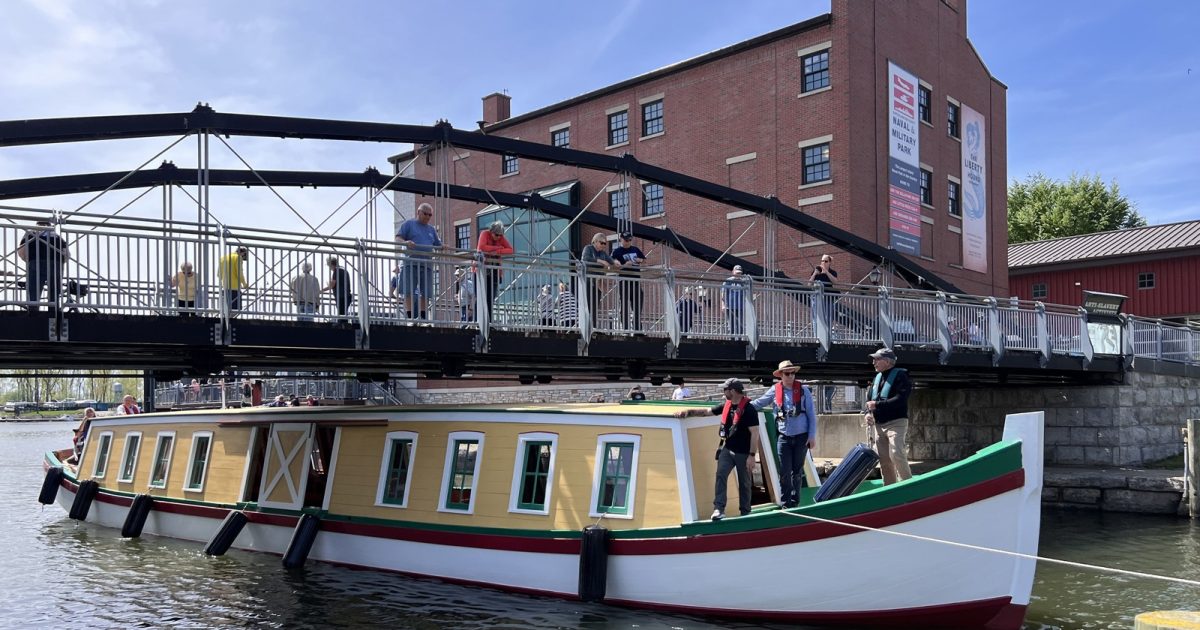
On a fine brisk October day in 1825, Brother & Governor Clinton in celebration of the completion of the Erie Canal boarded a small bunting clad canal boat accompanied by his wife, children, the surviving Canal Commissioners and other dignitaries. They traveled all along the entire canal route stopping at every community adjacent to the banks of the canal, where cannons were fired in salute and celebration. At Albany, Brother Clinton and his party traveled onboard the Seneca Chief, which was now in tow behind the flagship, Chancellor Livingston, for the remainder of the trip down the Hudson River accompanied by a flotilla of steamboats.
Special assistance from Mr. William D. Moore, Director, and Miss Jennifer Somerwitz, Librarian, of the Chancellor Robert R Livingston Masonic Library, NYC.
De Witt Clinton, by Dorothie Bobbé. Port Washington, NY, Ira J. Friedman, Inc., 1962
American Ships, by Alexander Laing, New York, NY, American Heritage Press, 1971
Chancellor Robert R. Livingston of New York: 1746 – 1813, by George Dangerfield, New York, NY, Harcourt, Brace and Company, 1960
Robert Fulton: Pioneer of Undersea Warfare, by Wallace S. Hutcheon, Jr., Annapolis, MD, Naval Institute Press, 1981
Robert Fulton, by John S. Morgan, New York, NY, Mason/Charter Publishing, 1977
Robert Fulton: A Biography, by Cynthia Owen Philip, New York, NY, Franklin Watts Publishing, 1985
America’s Maritime Heritage, by Eloise Engle and Arnold S. Lott, Annapolis, MD, Naval Institute Press, 1975
RWB Bateman is the Assistant Grand Secretary and Grand Pursuivant of the Grand Lodge F. & A.M. of the State of New York. He is also the recipient of the Charles Henry Johnson Medal, Chancellor Robert R Livingston Medal, George Peter Medal, Wendell K. Walker Medal, and Khalid E. Tabet Medal.
