Meanings of Masonic Symbols

Meanings of Masonic Symbols

MASONIC EDUCATION

Meanings of Masonic Symbols

THE ALL-SEEING EYE, GEORGE WASHINGTON AND LODGE OFFICERS

There are several well-known symbols associated with Freemasonry. The Square and Compasses, The Letter “G”, and the Trowel are three examples. In this post, we’ll explore three additional symbols and their meaning to Freemasons.

Bro Michael Arce

Bro. Michael Arce, Senior Warden (2021-2022), Mount Vernon Lodge #3

Lodge Officers

In our ritual, the three pillar officers of a Masonic Lodge roles are explained. In our public installation ceremony, the full officer line is installed and their responsibilities are affirmed. In a Masonic Lodge, the Worshipful Master is the presiding officer, similar to the president of an organization. The Senior Warden serves as the Vice President and the Junior Warden is like a 2nd Vice President. There are also appointed officers who serve at the will and pleasure of the Worshipful Master.

Freemasons who are looking for deeper meaning of the Lodge officer meanings could also make the following esoteric connections.

Worshipful Master — The Spirit
Senior Warden — The Soul
Junior Warden — The Intellect
Senior Deacon — link between the Spirit and the Soul
Junior Deacon — link between the Soul and the Mind

George Washington

George Washington is America’s Most Famous Freemason. Bro. Washington has a long string of “firsts” in American History: first commander in chief (Continental Army during the American Revolutionary War), first American “war hero” and first U.S. president (1789 to 1797). However, Bro. Washington shares the distinction of being one of the prominent Freemasons during the revolutionary era, which included Benjamin Franklin, Samuel Adams, James Madison, Alexander Hamilton, and Paul Revere.

Bro. Washington’s Masonic history began on November 4, 1752 when was obligated as Entered Apprentice at Fredericksburg Lodge, later renamed and numbered as Fredericksburg Lodge No. 4 after the creation of the Grand Lodge of Virginia in 1778. As president, Washington exchanged letters with many Masonic local and state grand lodges, along with meeting with Masonic delegations during his travels. His most significant Masonic activity, however, occurred on September 18, 1793. Acting as grand master pro tem, he presided at the Masonic ceremonial laying of the United States Capitol cornerstone.

Bust of George Washington

Bust of George Washington
George Washington University, Washington, DC
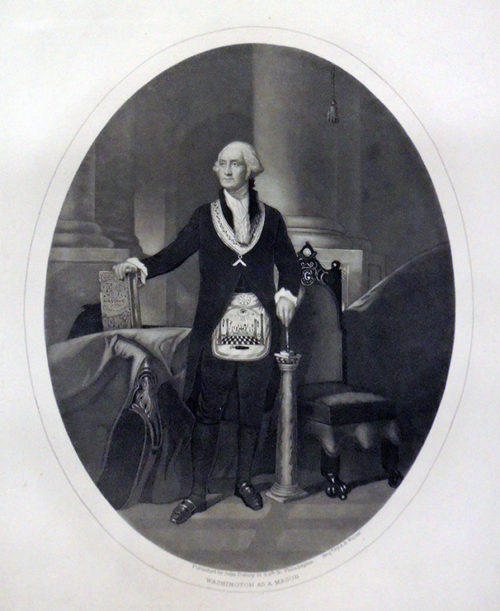
After laying down his Working Tools 1799, Bro. Washington’s legacy gained popularity over the years, as the nation’s grieved and memorialized the loss of our “Founding Fathers.” One image that catches the eye of visitors to Masonic Lodges is often the 1860 portrait of Washington entitled Washington as a Mason. This image, captures the spirit of American Freemasonry while also showcasing the symbolism that encourages all good men to seek the principles of Freemasonry that lead a righteous life.

“When one lives in integrity of the heart, one lives all the precepts, all the commandments without even knowing them.” — Bro. George Washington

The All-Seeing Eye

The All Seeing Eye, also known as the Masonic Eye or Eye of Providence, is an internationally recognized Masonic symbol. It dates back to 1797 when it was introduced in a publication of the Freemasons Monitor and has been associated with Freemasonry in America when another U.S. president who was also a Freemason, Bro. Franklin Delano Roosevelt, added the All-Seeing Eye as part of the great seal displayed on the back of the one dollar bill in 1935.

Although our thoughts, words and actions may be hidden from the eyes of man, that All-Seeing Eye, whom the Sun, Moon and Stars obey, and under whose watchful care even comets perform their stupendous revolutions, pervades the inmost recesses of the human heart, will reward us according to our merits.

Bro. Jim Simpson, Schenectady Lodge #1174, Schenectady, New York
Sigman Bodies Ancient Accept Scottish Rite, Scotia, New York
St. George’s Chapter #157, Schenectady, New York
St. George’s Council #74, Schenectady, New York
St. George’s Commandry #37, Schenectady, New York
Charles H. Copestake #69 AMD, Schenectady, New York

Fez Friday Damascus Shrine

Fez Friday Damascus Shrine

FUN & FELLOWSHIP

Fez Friday, Damascus Shrine

All Shriners are Masons

Greetings my Brothers!

This is Eric Morabito, “The Walking Man,” checking back in on Fez Friday. Over the past few years, I have started a collection of Shriner fezzes. I currently have fezzes from 43 different Shrine Centers and I am always looking for more. There are over 200 Shrine Centers worldwide and I try to visit as many as I can when I travel. To date, I have been to 65 Shrine Centers, 12 Shriner hospitals, and the Shriners International HQ in Tampa. When I retire, I plan is to donate my collection to the Cyprus Shrine Center.

Damascus Fez

Demascus Shrine

Dr. Walter M. Fleming, one of the original 13 founding Shriners, brought the idea to Rochester, NY, and helped to set up the Damascus Shrine. Dr. Fleming, together with William Florence, designed the fraternity’s emblem, devised the salutation, and determined that the red fez with the black tassel would be the groups’ official headgear.
On June 6, 1876, the Damascus Shrine received its charter and became the second Shrine. Originally the Damascus Shrine was in Rochester but is currently located in nearby Webster, NY. There are around 650 members of the Damascus Shrine and they support the Shriners Hospitals located in Erie, PA, and Springfield, MA. Whenever I travel, I make it a point to stop and visit Shrine Centers nearby. If open, I will introduce myself and usually receive a tour of the facility. I try to get a few pictures of my visits, especially of the ”Silent Messenger” statue that most Shrines have. I was intrigued by the unique statue that was in front of the Damascus Shrine. They are generally cast from cement or plaster and depict a Noble carrying a young female patient. I have seen them painted white, gold, brown, or realistically. The one that stands in front of Damascus was hand-carved out of a tree trunk and is quite impressive.
Bro. Eric Morabito “The Walking Man” Junior Deacon, Adonai Lodge #718 in Highland, New York Noble, Cyprus Shrine in Glenmont, New York
Eric Morabito
Fez Friday, Ziyara Shrine

Fez Friday, Ziyara Shrine

FUN & FELLOWSHIP

Fez Friday, Ziyara Shrine

All Shriners are Masons

Greetings my Brothers!

This is Eric Morabito, “The Walking Man,” checking back in on Fez Friday.

Mecca

Ziyara Shrine

The word “Ziyara” means “pilgrimage to holy place” but the members and Nobles of Ziyara, know that it means “The Friendly Temple.” The year was 1872. The Republic was rebuilding from the Civil War and U.S. Grant was serving as president. The country stood on the verge of what was to become the “Gilded Age” when business, economy, and industrialism would flourish. In New York City, the Ancient Arabic Order of Nobles of the Domestic Shrine was founded. The order membership requirement was that a man had to be a member of the York Rite, the Scottish Rite, or both.
No new temples of the fledgling order were formed until 1876. Charters were then granted to establish temples in nine cities. They included Rochester, New York; Montpelier, Vermont; Cleveland, Ohio; Albany, New York; Cincinnati, Ohio; Troy, New York; Pittsburgh, Pa.; Bridgeport, Conn.; and Davenport, Iowa. In Utica, New York, Frazier W. Hurlburt, who was an active Mason, became a member of the Shrine on a business trip to New York. It was Hurlburt who gathered a group of area men and sent for a dispensation to establish a Shrine Temple in Utica, NY. The dispensation is dated October 30, 1877, making Utica the 11th city to receive a charter. Ziyara Temple covered 50,000 square miles of territory from just east of Rochester, New York to just west of Albany, New York, and from the Canadian border to the Pennsylvania state line. On October 2, 1878, the first petitions were received from other men who wished to become members of the shrine. Those petitioners were from Oswego, New York. In those days the initiation fee was $5. It is recorded in many places that the Shriners from the beginning were quick to respond to calls for help from those who had suffered a disaster. It is recorded that Shriners contributed generously to the victims of the Galveston flood in the early 1900’s. Records show that in 1916, in response to a request from the Imperial Potentate, Ziyara Temple sent a check for $300 to Islam Temple in San Francisco to help the distressed nobles who were suffering from the effects of an earthquake and fire. Later, it will be noted that this charitable spirit became one of the basic principles of the shrine movement. Ziyara temple has many famous and outstanding sons. Four of its Nobles became Grand Masters of the Grand Lodge of the State of New York. At least five of its Nobles were members of Congress. Two local insurance companies had Ziyara Nobles as their chief officers. Among area bankers, three of Ziyaras Potentates were also the President of the Oneida National Bank. It is impossible to read the history of either Oneida or Herkimer counties without encountering the names of the outstanding judges, bank presidents, doctors, surgeons, lawyers, and businessmen who were members of the Ziyara temple. Because of the proximity to the Rome Air Base, there have been many distinguished officers of the armed forces as members. Also, many members have been mayors of their cities, towns, and villages. Three Ziyara Nobles were all members of the famous Sousa’s Band.
Bro. Eric Morabito “The Walking Man” Junior Deacon, Adonai Lodge #718 in Highland, New York Noble, Cyprus Shrine in Glenmont, New York
Eric Morabito
Fez Friday, Syria Shrine, Pittsburgh

Fez Friday, Syria Shrine, Pittsburgh

FUN & FELLOWSHIP

Fez Friday, Syria Shrine

All Shriners are Masons

Greetings my Brothers!

This is Eric Morabito, “The Walking Man,” checking back in on Fez Friday.

Mecca

Syria Shrine

On September 26, 1872, the original 13 members met in New York’s Masonic Hall, 114 East Thirteenth Street, for the purpose of formally organizing the Ancient Order of the Nobles of the Mystic Shrine (A.A.O.N.M.S.) for North America. The Shrine was born. (The organization is now known as Shriners International.) The new Shrine was not an immediate success in terms of membership. The spark that was needed to make the Shrine prosper apparently was the formation of the Imperial Council. That first meeting of the Imperial Council was brief, but in addition to the election of officers, it accomplished the establishment of the following temples: Mahammed in New Haven, Conn., Ziyara in Utica, N.Y., Pyramid in Bridgeport, Conn., and Syria in Pittsburgh.
Syria Temple became a reality on May 19, 1877. Officers were elected on May 29, 1877, for a permanent Syria organization. Samuel Harper, the first Potentate of Syria Shrine, was among those selected for roles as Past Potentates on the first Imperial Council. At the February 6, 1877 meeting The Council also voted to present each new Noble with a certificate, specified official jewels and costumes for the respective offices, and required each new temple to select an ancient Arabic or Egyptian name. It was between the late 1880s and the early 1900s that the Shrine enjoyed great membership growth and vigorous program activity. The famous Shriner’s fez was the subject of new legislation in 1915. New regulations prescribed that the red Turkish fez with black tassel be adorned only by the name of the temple and the scimitar and that part of the jewel of the order including the sphinx head and star. In 1913, the directors of the Syria Improvement Association mailed a prospectus outlining plans for a building on the old Schenley Farmland. The ground was broken for the new temple on April 20, 1915, and the cornerstone was laid on June 19. The formal dedication of the great building was a week-long affair, beginning October 23, 1916. The ceremony was held on October 26th. An estimated 40,000 guests attended the various activities. A feature that impressed visitors both then and to this day is the set of the bronze sphinx, two of which guard each portal of the building. A suggestion was made by Potentate Joseph N. Mackrell that an appropriate memorial is erected in memory of Nobles of the temple who served in the Army and Navy during World War l. There had been 529 such members, and their names are inscribed on the sphinx. The unveiling and dedication of the sphinx took place on November 1, 1919. The mosque represented an initial investment of half a million dollars and brought to the famous group of institutional buildings in the Schenley district a distinct new architectural touch. It was recognized as one of the best examples of “exotic revival architecture.” The 3,700 seat Syria Mosque ushered in a grand era of social and ceremonial events, and for nearly 75 years it contributed greatly to Pittsburgh’s cultural life. A movement began in the late 1980s to replace the aging Syria Mosque with a new facility that offered greater amenities to suit the needs of its members and its special events business. The Syria Mosque went up for sale in June of 1989. The building was demolished on August 27, 1991. In October 1994, the Pittsburgh Shrine Center opened its new, 40,000 square foot, $10 million facilities set on 37 acres in Harmar Township, Cheswick, PA. Great effort was spent to retain some of the classic features of the former Mosque, such as the twin sphinxes which guarded the entrance and the immense chandeliers which hung in the auditorium.
Bro. Eric Morabito “The Walking Man” Junior Deacon, Adonai Lodge #718 in Highland, New York Noble, Cyprus Shrine in Glenmont, New York
Eric Morabito
Sad Tidings Mrs. Joanne Kessler

Sad Tidings Mrs. Joanne Kessler

IN MEMORY

Sad Tidings

Mrs. Joanne Kessler

My Dear Brothers,

I know I speak for our entire Masonic Family when I say that our hearts are broken with the passing of our First Lady, Joanne, beloved wife to our Grand Master, and mother to Bro. Chris and Jeff.

We have lost too much this past year. Yet, the loss of our beloved First Lady hurts to the core. For anyone who knew this kind and caring woman, her passing has brought upon profound sadness.

Yet, while we mourn, as Master Masons we know that goodbyes are not forever. Goodbyes are not the end. They simply mean we will miss you until we meet again

Let us all keep our Grand Master, and the entire Kessler Family, in our thoughts and prayers. Below, I present the official announcement from our Grand Lodge.

Warmest Fraternal Regards,

Steven Adam Rubin
Deputy Grand Master

Dear Brethren and Friends of Freemasonry,

It is with a deeply troubled heart that we learned today that our First Lady of New York Masonry, Mrs. Joanne Kessler, has been called to the Celestial Home above. She passed from this life at 1:42 PM on Monday, December 27th.

Almighty God, Heavenly Father, grant Your consoling grace to all who mourn the passing of loved ones. Hear our prayers for those we love dearly who have gone before us into the life to come. Look kindly upon our departed family members, brothers and sisters, and especially Joanne Kessler whom we now entrust to Your eternal mercy and goodness. Welcome our beloved into Heaven where tears are no more and suffering and pain are ended, where there is great joy, abundant life and peaceful rest in Your gracious presence. Amen.

Cards and expressions of sympathy may be sent to our Grand Master, Most Worshipful Richard J. Kessler, and the Kessler Family at 62 Woodcrest Blvd., Buffalo, NY 14223-1317.

Funeral arrangements are yet to be made and shall be announced when received.

With kindest fraternal regards,

Richard W. Bateman, G.P.
Assistant Grand Secretary
Grand Lodge F. & A.M. of the State of New York