The 33 Degrees in Freemasonry

The 33 Degrees in Freemasonry

MASONIC EDUCATION

The 33 Degrees in Freemasonry

Is 33 a mystical number with an inherent meaning?

Editor’s Note:

In February 2018, I was invited to speak at Schenectady Lodge #1174 in Schenectady, New York. Afterward, I was approached by Bro. James (Jim) Simpson, who shared his interest in the topic of my presentation. Jim caught my attention in that he’s an older member, the kind of Brother who leaves you with the impression that he has in-depth knowledge of the craft, its symbols, and history. We exchanged contact information. It was early March of that year when I opened the package of his first paper, “The Thirty Three Degrees of Freemasonry.”

What first caught my eye was that all 12 pages, including the title page and bibliography, were handwritten. For a kid who grew up in the 1980s who wrote thank you letters to my grandparents for every gift they sent me, I can’t remember the last time I opened a piece of mail in the past five years that was handwritten. I read on.

“There are 33 such degrees in the Ancient Accepted Scottish Rite. Is 33 a mystic number some inherent numerical meaning?”

I was hooked. I read the entire paper that afternoon when I came home after work. Bro. Jim also included photocopies of his supporting documentation to source his research. As a graduate studies student, I felt like I was reading college-level work.

I present to you the first in a series of Bro. James Simpson’s writings. What is special, is that Bro. Simpson is in his early 80s. When we last spoke on the phone, he shared that he’s “taking a hiatus this summer because my mind is getting tired.”

What surprised me over the past few years during our friendship is that he started writing about five years ago. After he was raised, he started reading and didn’t stop. He had so many ideas that he wanted to share his knowledge. This started with “scribbled paragraphs that I would read in my Blue Lodge,” he said. And how were his ideas received? He was thanked with not much discussion. “That was pretty much the end of it. There’s no discussion because the speaker is the only one who has done the reading on the subject. But, others will come to you and thank you for sharing the matter. (Just as he did with me) Don’t be discouraged! All of the Brothers I have known are interested in becoming more adept in the craft as it relates to their position in the Lodge.” He wasn’t the first, nor sadly the last, to learn that some of Freemasonry’s esoteric thoughts and ancient history sometimes fail to connect with the Brothers.

I will be converting Bro. Simpson’s papers to text, my hope is to share them with you as I receive them. He is one of many of our craft’s hidden gems. It is important to me that the library of history in his mind, the handwritten papers that he freely shares with any interested Brother, that knowledge continues to be accessed. I understand, not all Masons seek the additional Light that was promised to us in the degree ritual — but we should. We all began as Entered Apprentices with a desire to know and learn. We need to secure for future generations those “scribbles” that can spark great ideas or thoughts for an entire Craft.

Michael Arce, Editor-in-chief, Craftsmen Online

The 33 Degrees in Freemasonry

There are 33 degrees in the Ancient Accepted Scottish Rite. Is 33 a mystical number with some inherent numerical meaning?

The great Shakespearean actor and Mason, Edwin Booth, reportedly once said of the Masonic Ritual: “In all my research and study, in all my close analysis of the masterpieces of Shakespeare; in my earnest determination to make those plays a appear real on the mimic stage, I have never, and nowhere met the tragedy so real, so sublime, so magnificent as the Legend of Hiram. It is substance without shadow — the manifest destiny of life which requires no picture and scarcely a word to make a lasting impression upon all who can understand.”

Degree Origination

Our degrees began in France in the year 1725. The new class of scholarly men (Speculative Masons) had discovered written legends from the old Operative Masons. They were also aware of the early history of the Jews given in the Bible. It is from these histories the Hiramic Legend evolved. The early high degrees were a continuation of the Hiramic Legend. This occurred during the Age of Enlightenment when there was a growing interest in all mystical and occult doctrines. The mystical parts of many of the high degrees were influenced by the knowledge of Rosicrucianism and even the mystical parts of the Book of Revelation.
Important practical lessons are being taught through the observance of rituals. Participation in rituals in unifying and gives a greater sense of belonging. A mutual belief in a Supreme Power should bind all initiates together in Brotherhood. We must learn to work for work’s sake without the desire for praise or reward. There are philosophical ideas shown allegorically through the master architect’s tools. They teach us to be faithful to our family and country. They teach universal Brotherhood; honesty in business relations; the forgiveness of past injustices; and perseverance in overcoming the difficulties encountered in our progress toward perfection. These degrees are rich in benefits.

Scottish Rite Degrees and Chakras

Several years before I was raised, I purchased a book entitled “Hands of Light: A Guide to Healing Through the Human Energy Field” by Barbara Brennan. She is a practicing healer, psychotherapist, and scientist. She was a research scientist in atmospheric physics from NASA. She was trained in bioenergetic therapy and is currently teaching courses concerning the human energy field. Barbara presents the first in-depth study of the human energy field for people who seek happiness, health, and their full potential. She discusses how our physical bodies exist within a larger “body,” a human energy field or aura, which is the vehicle through which we create our experience of reality, including health and illness.

There are seven endocrine glands. Each gland has a chakra, which is a cone-shaped energy field that absorbs energy from the universal energy field. As a practitioner, Ms. Brennan will locate unhealthy chakra. The result of her healing will be physical, emotional, and spiritual. Although this healing is not a religion, the charkas are a western interpretation of Hinduism. Western practices have associated chakras with various concepts.

I.E., metaphysical counterparts to the endocrine glands; chakras reside in the psyche; chakras have a physical manifestation. These various beliefs have been speculative. The book “Dark Light Consciousness” has taken the speculative out of the chakras and brought them into the operative world of science. The book author, Edward Bruce Bynum, Ph.D., explores the ancient Egyptian science of the Uraeus and reveals how it is intimately connected to dark matter and to melanin, a light-sensitive, energy-conducting substance found in the brain, nervous system, and organs of all higher life-forms.

The following points are from Ms. Brennan’s book.

  • Chakra #1: The coccygeal center is related to the quantity of physical energy and will live in the physical reality.
  • Chakra #2: The gonads is related to the quality of love for your mate.
  • Chakra #3: The solar plexus relates to spiritual wisdom and consciousness of universality of life.
  • Chakra #4: The thymus is the center through which we love ourselves, our families, pets, friends, neighbors, and our countrymen.
  • Chakra #5: The thyroid is associated with taking responsibility for one’s personal needs.
  • Chakra #6: The pituitary is associated with the capacity to visualize and understand mental concepts.
  • Chakra #7: The pineal, the “Crown Chakra.” The pineal gland is related to the person’s connection to his spirituality and integration of his whole being, physical, emotional, mental, and spiritual.

Spritual energy and Freemasonry

The Knights Templar were in the Holy Land beginning in the year 1118. Hughes de Payens, the Master of the Order, although a Christian, was a descendant of Muhammed. It was through this connection that the Templars allied themselves with Islam. The Templars’ principal teachers of alchemy were the enlightened Sufis. The Sufis had gathered the rarest and most valuable alchemical texts of the Egyptians, Persians, and Indians. The Sufis also acquired texts from India regarding the mystical form of spiritual enlightenment.

The human spine contains 33 vertebrae. Spirit regeneration would take place by degrees through the 33 vertebrae of the spinal column until reaching the pituitary gland which invokes the pineal body. The science of this regeneration is one of the lost keys of Freemasonry, and it is this reason why ancient Freemasonry was founded upon thirty-three degrees. Manley P. Hall, a 33 Degree Mason and Masonry’s greatest philosopher, states, “The 33rd Degree represents the human head atop the 33 vertebrae of the back.”

From the base of the spine there is the serpent which will wind its way up the spine to the crown chakra. The Sufis knew this as the Baraka; the Jews called it the Shekinah; the Chinese Taoist called it Jing; in India, it was the Kundalini. To awaken the power of the Kundalini, it would take spiritual discipline, including alchemy and yoga. As the Kundalini rises through the physical, emotional, and mental bodies, it performs the task of destroying all the impurities that prevent him from knowing his innate divinity.

With the conquest of Spain by Islam (711-1492), Spain became the seat of Sufi learning in Europe. Beginning with Compostela, Spain, there are five cathedrals, one church, and one chapel. The sequence of the sites corresponds to that of the planets in our solar system. Each site also corresponds to a chakra. Just as subliminal energies stream up and down through the chakras within the human body, so similar forces surge northwards and southwards along the great alignment of the cathedrals.


When the novice had progressed thus far along his chosen spiritual path, he was open to receive the messenger of the mystery cults. The novice would make a pilgrimage to St. James of Compostela. The first-degree initiation was the result that flowed spiritually from the awakening of the base chakra that connects us with the earth and physical reality. Its ruling planet — the Moon.
The initiate would then make a pilgrimage to the church in Toulouse. He would be introduced to the mysteries of the second degree with the opening of the abdominal chakra. Here he would discover his inner space and could retire into the isolation of his spirit. Its ruling planet — Mercury.

The novice was the symbol of the third or solar plexus chakra. The fulfillment of this degree led to the awakening of the universal life force. This degree was achieved by the entry into the mysteries of the Venus oracle at the Cathedral of Orleans.

The novice is now ready to awaken the heart chakra which is linked to the region of the thymus gland above the heart. This is the spiritual center controlling the sublime gifts of love. This initiation was held in the Crypt of Chargers Cathedral, the ancient site of the sun oracle.

Induction into the fifth degree was performed in the chamber under Notre-Dame de Paris, the site of the druidic oracle of Mars. The fifth center is the throat chakra and is the first of the higher ones. It is the center of both speech and inner hearing and is connected with the power of sound.

The brow chakra, known to many as the third eye, is connected with the pituitary gland. Clairvoyance is connected with this center, which relates to the spiritual faculties of insight and intuition. This took place in the cathedral of Amiens, and the aspirant would be instructed in the mysteries of the Jupiter oracle.

The seventh degree was attained with the culmination of the spiritual journey a the opening of the crown chakra, which is mystically united with the pineal gland; also known as the Seat of the Soul. This was awarded at the seventh site, Rosslyn Chapel, the ancient and revered site of the Saturn oracle. The initiation ceremony for this degree took place in the hidden chamber under the chapel, which was deliberately created by Earl William St. Clair. The Sinclairs were experts in sacred geometry and geomancy, sciences that teach how to design physical structures so that they harmonize, capture, and amplify the natural currents of energy that flow under and upon the surface of the earth. William Sinclair based the chapel’s dimensions on the Golden Mean, the proportion that determines the geometric spiral, which is synonymous with the path of serpentine life force.

Rosslyn Chapel was situated upon the confluence of important ley lines that united it with sacred landmarks throughout Britain. One of its intersecting leys comes from the direction of the bore stane hill where five powerful ley-lines radiate. In 1994, Niven Sinclair invited Professor Lin Yun, a master of Feng Shui, to measure the flow of the “earth energy” within Rosslyn Chapel. Professor Yun was impressed with this energy and maintained that the chapel was destined to be a center of world peace.

The seven spiritual centers along with their respective planets were in total alignment on July 28, 2019. The author did not make any predictions for this alignment.

Bro. Jim Simpson, Schenectady Lodge #1174, Schenectady, New York
Sigman Bodies Ancient Accept Scottish Rite, Scotia, New York
St. George’s Chapter #157, Schenectady, New York
St. George’s Council #74, Schenectady, New York
St. George’s Commandry #37, Schenectady, New York
Charles H. Copestake #69 AMD, Schenectady, New York

Clandestine Masonry

Clandestine Masonry

EDITORIAL

Practicing “Safe” Masonic Intercourse

The Moral Debate On Clandestine Masonry

Editor’s note: This article was originally published on The Midnight Freemasons blog and is being republished by permission of the author. This version contains updates.

Morality. You will hear that word many times as a Freemason. Merriam-Webster has four definitions for morality. I believe the one that best fits the discussion of clandestine Masonry is: “a literary or other imaginative work teaching a moral lesson.” Ironically, Merriam-Webster lists “Aesop’s Fables” as a “famous example of morality.” While the subject of clandestine Masonry is a vast, unknown entity to many Freemasons, what is clear is: clandestine groups claim to seek the same “morality” that we, as Freemasons, overtly pursue. The problem is, their members are all too often unknowing participants in their covert, fictitious work.

Often, when we think of clandestine Masons, the idea of someone wearing a Masonic ring purchased at an estate sale, possessing an apron that is not their own, or claiming to know “our secrets.” The image of a copycat, wannabe, or pretender presenting fake credentials to access a conversation or find relevance. Someone who holds the rank and title of Freemason as a status symbol, not as a privilege. In reality, clandestine Masonic groups not only mimic our dress, degree systems, ritual, and education — they also try to claim legitimacy in our communities. These groups are not quiet “pretenders,” rather the opposite; they are well organized, well funded, and target interested gentlemen who have a sincere desire to become a Freemason.

Three common themes surfaced during my research on clandestine groups: intent, race, and realization. Through the stories of Brothers who began their Masonic journey seeking Light, we find that their clandestine experiences, while wildly different than ours, originate from the same point: in their heart.

The Clandestine Experience

“I was Junior Warden of my Lodge, Junior Deacon of the District,” began Bro. Alvin Gyles, Mt. Vernon Lodge #3, F&AM – Albany, NY, Ancient Temple Chapter #5 RAM – Albany, Bloss-DeWitt Clinton Council #14 – Albany. “And, I was in Queen of the South and Royal Arch. The only thing I was missing was the Shriners which they consider the highest degree.” The “they” here is a local group of International Free and Accepted Modern Masons, a corporation based out of Detroit, Michigan. International Masons and Easter Stars Worldwide is an unaffiliated clandestine group, not recognized by The Grand Lodge of the State of New York — in turn, is not recognized by ANY Masonic jurisdiction in the United States. This clandestine group looks, feels, and acts legitimate but is far from having the title of Freemasons.

Bro. Gyles’ intent was pure; he wanted to follow his uncle’s footsteps, a Past Grand Master in Prince Hall. “He had a big impression in my life with the square and compasses,” reminisced Gyles. “When I was growing up, since my name started with an ‘A.’ I would draw the square and compasses with my letter ‘A.'” Yet, Bro. Gyles’s first masonic experience was clandestine. He unknowing invested almost four years of his life with the International Masons after meeting a member through his church.

Five years into the experience, at 23 years old, Bro. Gyles noticed that his dues kept increasing. The cost didn’t rise because of changes in the economy; the sources that called for contributions grew over time. He did the math; he was paying almost $200 a month! “When I first started, it was $25 a month. By the time I stopped, it was $35. Once you are a member, you paid district fees. That was another $12 every Saturday plus the raffles.” Wait, raffles?These weren’t charitable or legitimate non-profit efforts. No, this fundraising was for the clandestine treasury, paid for by the members. “Every month you would get a book of tickets you have to sell. They were $25 a book. You don’t wanna hassle everyone you know, every month, so you basically buy those too. You get one from your Lodge, District, and Grand Lodge.” He began wondering where all of this money was going since Bro. Gyles would often pay for dinner and items needed for degrees.

At this point, I had to know, just as you are probably thinking, how did this group perform their ritual? What is their education and history? What exactly are they telling (and selling) to their members? The International “Modern Masons” consider the Shrine the highest degree. Bro. Gyles explained their degree system. “Basically, we had three degrees in Blue Lodge,” he started. “Then you have to get your Eastern Star Degree. After the Easter Star, you become a member of the Queen of the South. Then comes Royal Arch, Scottish Rite, and you end up as a 32nd degree Shriner.” This group used the Duncan Ritual, which you can purchase on Amazon for under $20. “When I do ritual work now, I have to stop at certain moments to pull back the clandestine words because they are memorized. It’s like a lyric from your favorite song that has another version that is played on the album versus the radio.”

If you are keeping score:

☑ This group approaches men who show an interest in Freemasonry
☑ To apply, men fill out a petition, in this case, online
☑ Initiated men are put through a degree system
☑ Their ritual is not secret
☑ Dues are paid weekly
☑ They claim to be founded upon Christian values

So far, some of what clandestine groups offer is similar to Freemasonry, but we are starting to see a few differences. Oh, and there is a major distinction that Bro. Gyles revealed.

“The only physical building this group has is in Detroit.”

Bro. Alvin Gyles

Bingo! That fact surfaced when Bro. Gyles researched this group’s legitimacy after a fellow member tried to petition another recognized Masonic body and was denied. At that point, Bro. Gyles was told the Modern Masons group was not a recognized Masonic Body, as they could not produce a copy of their charter. There is a formal communication process between recognized Grand Lodges that facilities these requests to regular Freemasons, but to clandestine members, this is an awakening moment.

Creating Racial Division

Bro. Gyles continued to seek the truth. He reached out to his Grand Master for answers. “He was the most honest one we spoke to,” noted Bro. Gyles. “He came back to us and said, ‘This is what it is: they consider us clandestine… but who are they to call us that? We did the same process that they did to start their Lodges. Who tells these white guys they can do it and we can’t?'” It’s not uncommon for some clandestine groups to play to the same racial tensions that have historically divided good men in our country since the birth of our democracy.

When I looked at the homepage of the International Masons, as the pictures cycled on the screen, I noticed they all shared one thing in common: the members pictured were all African American. Historically, the general thought is that as black men sought admittance to Freemasonry, they were excluded or prevented from joining. At that point, their only recourse was to join other groups, like Prince Hall Lodges. Since Prince Hall Lodges have only recently (the late 1990s to early 2000s) been recognized as regular Masonic bodies by the independent Grand Lodges in jurisdictions across the United States. 42 Grand Lodges, including the Grand Lodge of the District of Columbia (Washington, DC), have Prince Hall Grand Lodges. A handful (Georgia, Mississippi, Louisiana, Arkansas, South Carolina, and West Virginia) do not. This divide created an opening for other groups to promote the values of Freemasonry while positioning their organization as a body that offered acceptance to members of the black community.

This might explain the development of “progressive fraternal orders” and their use of the Square and Compasses with the letter “G” in their logo. Upon further careful examination, you’ll notice an addition (like the symbol for a key) or other slight variation that to the initiated are clear indicators of clandestine Masonry. These groups benefit from the fact that one would have to know the difference. Like the viceroy butterfly that mimics the monarch, clandestine groups appear legitimate to the untrained eye. This stealthy deception allows these groups to exist in the same mind space as Masonic Lodges and Temples that have legitimately been in the community for generations.

When I spoke with another former clandestine Brother, “Brother C,” he presented a similar story. He approached a friend, who was a clandestine member, inquiring about Freemasonry. He did not know that he was talking to a clandestine Mason. “Brother C” then went through the Blue Lodge ritual to earn his Master Mason degree. It wasn’t until he was asked about his background when he tried to affiliate with a recognized Lodge that he discovered the sad truth. “Brother C” is also an African American. Like Bro. Gyles, he eventually went through the steps to become a legitimate Mason. As “Brother C” tells is, “after I approached by a true Brother who then asked about my background, I came to find out that I was a clandestine Mason. I was extremely disappointed because my original sponsor had passed. I don’t believe that he knew we were clandestine either. I wanted to be a legitimate Mason.”

The Realization of Freemasonry

If you visit your Grand Lodge website and then scan a clandestine page, you’ll find that both are a starting point for good men looking to be better. Both will have photos of gentlemen wearing aprons and regalia or other Masonic images. When I scanned through the pages of recognized Masonic Grand Lodges, every site shared the same bond to our history. “The oldest fraternity in the world… created in 1717… one Grand Lodge in each state and the District of Columbia… with references to famous Freemasons like Franklin, Washington, Roosevelt, or Truman.” We offer the authentic history that interested men want to be a part of.

Think back to the last interaction you had with a gentleman who was interested in Freemasonry. What questions did he ask you? What questions did you ask him? In my conversation with “Brother C,” he discussed how he has traveled to Lodges outside of his jurisdiction as a Freemason. He explained the examination process, “I know this now because you may not know you are a clandestine Mason when you are one.” How painful that reality must be. “You are going to always feel like you were robbed of your time,” echoed Bro. Gyles. “I was dedicated and put myself in it. Time is the one thing I will never get back. This also caused relationship problems. My clandestine Lodge took me away from my family for hours. In the end, it was all gone.”

Understanding Our Obligation

The wording will differ across our jurisdictions, yet we can all agree that as Master Masons, we are prohibited from discussing anything Masonic in nature with clandestine men. The problem is, most of us don’t know what or even IF we can say anything to a clandestine member. I reached out to RW Bro. Oscar Alleyne, Junior Grand Warden, Grand Lodge of the State of New York, F&AM, for more insight on this issue. Oscar is widely considered an expert in our Craft on the subject. He delivered an eye-opening presentation, “The Prevalence of Clandestine Freemasonry in the United States,” at Masonic Con 2017, held at Ezekiel Bates Lodge in Attleboro, Massachusetts.

“I have often found that when speaking with Worshipful Masters or in Lodge discussions, many of us are unsure of how to interact with clandestine members,” said RW Bro. Alleyne. His words prompted me to pick up my ritual book. “People hear the word ‘intercourse’ and wonder what that means. It’s true: you are not supposed to talk about ritual or the secret work of Freemasonry. But, you can have a conversation with any gentleman about what it means to join a Lodge and the process for legitimately joining a Lodge.” The challenge to Freemasons is finding the appropriate time or method to gently explain the massive difference between clandestine and recognized Masonry.

Pictured: RW ELQUEMEDO O. ALLEYNE, Past Junior Grand Warden

Gaurding the West Gate

One unique aspect in obtaining membership in a recognized Masonic Lodge is that the members of the Lodge ballot on accepting interested gentlemen. The Grand Lodge of New York has instituted a Northstar program to provide a detailed guideline of how to navigate the path of membership with candidates. There is a process to becoming a Mason one that builds over time to complete the three degrees and earn the title of Master Mason. One cannot simply “fill out an application online” or visit a Lodge, pay a membership fee and gain access. Recognized Lodges need to consider that as society emerges from the COVID pandemic social restrictions, we could experience an influx of men seeking interest in our beloved Craft. It would be wise to have dedicated members of your Lodge, prepared and trained to properly welcome and meet with interested gentlemen who are searching for that which they are unfamiliar. We would not want these men to fall into the shadows of clandestine groups that prey on bad information or lapses in response.

We should also implore positive intent and maintain an open heart during our encounters with clandestine men looking to affiliate with our Lodges. Instead of looking at these men as “the hackers of Freemasonry” or malicious evil-doers, keep in mind these men are preachers, the guy you work with, or someone who also volunteers to serve in your community. The subject of being clandestine should be approached with caution. Bro. Gyles, who still sees members from his past group, advises that “every situation is different. Everyone isn’t open to hearing that they are a member of something that is fake. When you get into these clandestine Lodges, they program in your mind that they are right and that anyone who says differently is a liar and you need to protect your family.”

“Brother C” advises using caution as well. “If I came across a clandestine Mason, I would let him speak. If it was just somebody passing by, I would not say anything. If it was a gentleman who had a sincere interest, then if I am in a particular jurisdiction (i.e. outside my Mother Lodge), I would seek permission to see if I could speak with that gentleman.” It’s important to note that as Master Masons, we are also instructed to be good members of the community in which we live. RW Bro. Alleyne summed up that duty the best. “We need to embrace who we are, express greater interaction among our recognized bodies, and also, engage the community so that people get a better understanding of what we are. These steps will build a better pathway to joining our Lodges!”

Written by Bro. Michael Arce
Editor-in-chief of Craftsmen Online
Mt. Vernon Lodge #3, Albany, New York

1945 Grand Lodge

1945 Grand Lodge

EDITORIAL

1945 Grand Lodge

balancing masonic obligations with the laws of the land

Freemasons share a special bond and a profound legacy that continues to flourish across generations. We are reassured that the past leaders in our Craft, have safely guided the Fraternity through even the darkest moments of history. One such event took place in the year 1945 when a Grand Master was in the unique position of performing the duties of his office while also following the rule of law. As we continue to seek to learn from the lesson of time, we find Grand Master Charles W. Froessell’s 1945 Grand Lodge Session Decision which provides an example of Masonic leadership during a time of crisis.

The iconic image of “Victory over Japan Day,” or “V-J Day,” August 15, 1945.

The Year is 1945

In 1945, the minimum wage was 40 cents, and a man earned an average of $16 for a 40-hour workweek. A gallon of gas cost 15 cents. A movie ticket was 35 cents and box seats to Game 7 of the 1945 World Series at Wrigley Field were $7.50 each. The microwave, cruise control, and the block heater were invented. Popular music artists included The Andrews Sisters, Perry Como, Bing Crosby, Louis Armstrong, Ella Fitzgerald, Dinah Shore, and Frank Sinatra. Elvis Presley made his first public appearance at the age of 10. The Slinky was a hit holiday toy. Radio was still king and Arthur Godfrey Time, The Kraft Music Hall, and The Lone Ranger were some of its top programs.

It was indeed a fascinating time and the events of that year would forever change the course of history. At the start of 1945, the Yalta Conference began, as did the bombing of Dresden, the Battles of Iwo Jima and Okinawa, and the Battle of Berlin. President Franklin D. Roosevelt died, Prime Minister Benito Mussolini was hanged by Italian partisans and German Chancellor Adolf Hitler committed suicide in Berlin. Meanwhile, the Grand Lodge of New York was faced with a unique dilemma: to ensure that a constitutionally mandated Grand Lodge Session could assemble while complying with wartime travel restrictions that would prevent upstate Grand Lodge delegates from traveling to New York City.

World War II and the Office of Defense Transportation

On December 18, 1941, just one week after the United States declared war on Japan, Germany, and Italy, President Roosevelt signed Executive Order 8989 establishing the Office of Defense Transportation (ODT). This long-forgotten sector of U.S. bureaucracy was in operation for only seven and a half years. During its brief tenure, a dozen presidential executive orders were established, modifying and expanding the agency’s authority over its quickly growing staff, from its Washington, D.C. headquarters to its regional offices in nine other U.S. cities.

The ODT’s mission was direct: to “assure maximum utilization of the domestic transportation facilities of the Nation for the successful prosecution of the war.” The Office’s responsibilities included coordinating the private industry, local, state, and federal estimates of fuel, steel, and other material required for the war effort. The ODT was also responsible for managing the complex schedule of shipping petroleum by land, pipeline, rail, and sea, organizing mass transit for inter-city travel, constructing warehouse facilities, and many other crucial projects to ensure the successful prosecution of the war. To meet these objectives, the ODT instituted travel restrictions as a nationwide effort to conserve fuel for the war effort.

On April 30, 1945, Hitler committed suicide. Germany formally surrendered on May 7, 1945, but the war against Japan was still raging in the Pacific. The ODT advised that the redeployment of troops from Europe to Asia would be critical and extended travel restrictions for an additional 15 months beginning in May 1945.

The nationwide travel restrictions and gas rationing resulted in the cancellations of many large gatherings, including the 1945 MLB All-Star Game. Freemasons throughout the country were not exempt from these government restrictions. Thus, in April 1945, as Most Worshipful Froessel was concluding his first year as Grand Master, he was confronted with this dilemma ― his obligation to protect and defend our Constitutions and the rights it affords all members, with his obligation to abide by the laws of the land as a Master Mason and a loyal citizen. Grand Master Froessel could have simply canceled the Session, arguing that it could not be held due to governmental restrictions. Yet, Grand Master Froesel understood that, whatever it took, he had to fashion some creative solution to permit the opening of the 1945 Grand Lodge Session once restrictions were lifted.

MW Charles W Frossel

Grand Master Charles W. Froessel

MW Charles W. Froessel was born on November 9, 1892, in Brooklyn, New York to Theodore and Barbara Froessel. He received his undergraduate law degree in the United Kingdom in 1913 and passed the New York Bar in 1914. He served as a lieutenant of the United States Navy during World War I and soon became Counsel to the Sheriff of Queens County, NY. Between 1924-1930, Froessel was Assistant District Attorney of Queens County.

While an assistant district attorney, Froessel tried the murder case of Albert Snyder involving a scheme to collect on his life insurance. The accused were his wife, Ruth Snyder, and her lover, Judd Gray, who claimed to be a “dupe and a slave under her domination.” They were convicted and executed on January 12, 1928, in Sing Sing Prison. This trial inspired the 1954 movie Double Indemnity, starring Fred MacMurray, Barbara Stanwyck, and Edward G. Robinson.

Pictured: Charles W. Froessel, Associate Judge of N.Y. Court of Appeals. Image courtesy of New York Law School.

Grand Master Froessel further served as Special Assistant to the U.S. Attorney General in charge of slum clearance projects in New York City from 1935 to 1937. In January 1937, he was appointed as a justice of the City Court in Queens County and was elected to the New York Supreme Court (2nd District) in November 1937.

After the war, Froessel successfully ran on the Democratic ticket to the New York Court of Appeals, becoming an Associate Justice of the highest Court in the State of New York. In 1951, he wrote a concurring opinion on school prayer, arguing that non-sectarian school prayer was constitutional, whereas daily school prayer was unconstitutional. He retired from the bench at the end of 1962 when he reached the constitutional age limit of 70 years.

After his retirement, Froessel served on the board of trustees and as a dean at New York Law School. A 33rd degree Mason, Froessel was Chairman of the Conference of Grand Masters of the United States (1946-47) and Chairman of the Masonic World’s Fair Commission that was held in Flushing, Queens (1964-1965). The M:.W:. Charles W. Froessel Award for Distinguished Service has been awarded in the Queens Masonic District for several years. The current Grand Secretary of Masons in New York, R:.W:. Richard Schulz was a recipient of this award in 2006.

Grand Master Froessel never retired, however, from his lifetime of service and visiting those “faraway places with strange-sounding names, far away over the sea,” even visiting Antarctica at the age of 88. His was a life of service and action. He died on May 2, 1982, at St. Vincent’s Hospital in Manhattan.

Froessel was not an “activist” judge, but rather one who believed strongly that “neither the courts nor the executive has the right to ignore the will of the people as clearly expressed in the legislative mandate of their duly elected representatives.” He followed this philosophy as Grand Master.

Grand Lodge of New York Token

Froessell’s 1945 Grand Lodge Session Decision

In April 1945, Froessel delivered a statement concerning the upcoming Grand Lodge Session scheduled for May 7 and 8.

It read in part, “Inasmuch the presence of representatives of at least 10 Lodges is indispensably necessary to open the Grand Lodge or transact business therein, we may not constitutionally proceed. Of course, we all understand the circumstances. Section 103 of our Constitutions prescribes that the Annual Communications of this Grand Lodge shall be held commencing on the first Tuesday of May. Our Government has requested, in the interests of national security, that all civilians refrain from unnecessary travel, and that any convention or assembly involving the attendance of more than 50 traveling persons be not held for the time being. As Masons, we cheerfully complied with the Government’s request, and the notice and proclamation with which you are all familiar were sent to all persons entitled to be present at this communication on April 2nd last.”

But the Grand Master did not stop at his postponement announcement. Froessel continued, “Before doing so, however, I think it is only fair to the Craft that the reports of our Officers and Chairman of Committees should be received, so that all of our Brethren may have free access thereto through the Grand Secretary’s office for their information. In the event that the travel restrictions should be relaxed hereafter, and I have not only hope but expectation that they will, the adjourned Communication of Grand Lodge may be held, when all those entitled to be present may attend and the usual business of Grand Lodge shall be conducted. In the meantime, Grand Lodge may function as usual.”

The Lesson of 1945

The technology for telephone conferencing would not be available for another 15 years, in 1960. Even then, it would not have the capability to gather hundreds and even thousands as modern platforms, such as ZOOM, Google Meet, and Skype currently afford. Thus, without the technology available to circumvent travel restrictions, Grand Master Frossel had two choices, cancel Grand Lodge or “postpone” the Regular Session.

This was required because our Constitutions require that only at a “regular” Grand Lodge Session held in May can the election of Grand Lodge Officers, voting upon amendments to our Constitutions, and other like proceedings occur. Thus, had Grand Master Frossell canceled the May 1945 Grand Lodge Session, any future Grand Lodge Session held prior to May 1946 would have been considered “special,” and the election of Grand Lodge Officers, voting on Constitutional amendments and other like proceedings would not have been constitutionally permissible. Therefore, Grand Master Frossel, his Judge Advocate, his Committee members, and others, crafted the only solution available, a procedural maneuver postponing the regular Grand Lodge Session, so that the regular Grand Lodge Session could thereafter be reconstituted whenever conditions permitted. Grand Master Frossell demonstrated an understanding of his obligation to the law of the land and the law of the Craft. It was an acknowledgment of the importance of our Constitutions and the obligation to follow its mandate, especially the most important provision ― to ensure that we gather.

In 1945, facing an unprecedented crisis that demanded leadership and the careful examination of solutions, Grand Master Froessel demonstrated by action and deed that he was not the law, but merely its servant. That as Grand Master, he was not the power ― Grand Lodge in Session was the power ― he was merely its caretaker, and that it was his obligation to find any solution that preserved its integrity. His example of servant leadership, the practice of putting the membership of an organization above the personal pursuits of its leadership, are lessons of that time and for all time.

Researched and written by the Brothers of the Craftsmen Online Editorial staff

The Grand Lodge of Rhode Island

The Grand Lodge of Rhode Island

MASONIC HISTORY

The Grand Lodge of Rhode Island

Small Jurisdiction,
Large Impact On History
& Freemasonry

While the Grand Lodge of Rhode Island is a small Masonic Jurisdiction, we have a large and historic heritage with connections to our colonial Brethren. I am proud to detail the lives of three of The Ocean State’s most prominent men and Freemasons. One shares a particularly close tie with the York Rite in New York State. I hope you enjoy this reflection on Masonic history. And should your travels bring you to Rhode Island, know that you are warmly welcomed, my Brother!

MW Christopher Champlin

Christopher Champlin

Christopher Champlin was born in Charlestown, RI, on February 7, 1731. At an early age, he showed a great disposition to serve his country. He received the appointment of Major in the Rhode Island Regiment at a young age. He moved to Newport and became involved in mercantile life, confining his attention to the importation of dry goods. In time he invested in shipping which he prosecuted with marked success and became quite wealthy. He owned much property in Newport, many large stores and warehouses on the wharf which still bear his name. He served sixteen years as a member of the Rhode Island Legislature. He was also mainly responsible for establishing the Bank of Rhode Island and was elected as its first President.

Christopher Champlin was an able and zealous supporter of Freemasonry and for a number of years, especially active in promoting its interests. He united with other influential Brethren of Newport and Providence in the formation of the Grand Lodge of Rhode Island and was elected Grand Master of the body, thus established in 1791. He rendered long and faithful service to the Craft.

Upon his death the family created the Champlin Foundations which are private foundations that make direct grants to tax-exempt organizations and are one of the oldest philanthropic organization groups in Rhode Island.

Nathaniel Greene

Nathanael Greene

Nathanael was the son of Nathanael Greene, a Quaker farmer, and the great-great-grandson of John Greene and Samuel Gorton, both of whom were founding settlers of Warwick, Rhode Island. Nathanael was born on Forge Farm at Potowomut in the township of Warwick, Rhode lsland, on August 7, 1742. His mother, Mary Mott, was his father’s second wife. Though his father’s sect discouraged “literary accomplishments,” Greene educated himself, with a special study of mathematics and law. The Rev. Ezra Stiles, later president of Yale University, was a strong influence in the young Nathanael’s life.

In August 1774, Greene helped organize a local militia, which was chartered as the Kentish Guards that October. His participation in the group was challenged because he had a pronounced limp. At this time he began to acquire many expensive volumes on military tactics and began to teach himself the art of war. In December 1774, he was on a committee appointed by the assembly to revise the militia laws. His zeal in fighting the British and organizing the militia led to his expulsion from the pacifistic Quakers.

On May 8, 1775, he was promoted from private to Major General of the Rhode Island Army of Observation, formed in response to the siege of Boston. He was appointed a brigadier of the Continental Army by the Continental Congress on June 22, 1775.  General Washington assigned Greene the command of the city of Boston after it was evacuated by the British in March 1776. Letters of October 1775 and January 1776 to Samuel Ward, then a delegate from Rhode Island to the Continental Congress, favored a declaration of independence.

On August 9, 1776, he was promoted to be one of the four new major generals and was put in command of the Continental Army troops on Long Island; he chose the place for fortifications, and supervised the construction of redoubts and entrenchments (the site of current-day Fort Green Park) east of Brooklyn Heights, NY. Severe illness prevented him from taking part in the Battle of Long Island. Greene was a Rhode Island Freemason and bore a Masonic jewel, the gift of his Masonic Brother the Marquis de Lafayette, on his person throughout the whole of the revolution.

RW Thomas Smith Webb

Thomas Smith Webb

Thomas Smith Webb, the “Founding Father of the York or American Rite” as he is appropriately described by Herbert T. Leyland, his biographer, was born October 30, 1771, in Boston. He holds the rare distinction of being actively connected with the formation of two large national Masonic bodies a testimony to the respect in which he was held by his Masonic brethren.

His Masonic career was full, extensive, and varied. While he received his initial Masonic education in Rising Sun Lodge, Keene, N.H., at age 19, it was in Albany and Providence that most of his activities and contributions occurred.

In Albany, at age 26, he authored his Freemason’s Monitor or Illustrations of Masonry, a literary work that ultimately went to seven editions. It brought international fame to the author and became the standard of ritual exemplification for many jurisdictions. It was a compendium of many of the writings of William Preston of England, a man who devoted a lifetime of service to the Craft in the study and perfection of Masonic lectures.

Webb joined Union Lodge in Albany and became its Worshipful Master. He helped form Temple Royal Arch Chapter and became its High Priest. His reputation was well known when he moved to Providence in 1799, and he was soon taken into the life of the community.

Soon after his arrival in Providence, he accepted an invitation to join St. Johns Lodge No. 1 Providence and at once started a school of instruction. As a member of a Rhode Island lodge, he was eligible to attend Grand Lodge, and on his first visit, he was appointed a member of a committee to revise the Constitution. It is interesting to note that within the next two years two amendments to the Constitution were adopted which permitted the utilization of the services of Brother Webb. One amendment repealed a two-year limit on the term of the Grand Wardens which allowed Webb to serve for three years as Grand Senior Warden. The other made it possible to elect a Grand Master who was not a Past Master of a Lodge in Rhode Island. Thus it was in order to elect Webb as Grand Master in 1813 and 1814. A further election in 1815 he declined.

Webb also accepted an invitation to join Providence Royal Arch Chapter and was elected its High Priest two years later. He assisted in the formation of the Grand Chapter of Rhode Island and served as Grand High Priest from 1804-14. With others, he eventually organized the General Grand Royal Arch Chapter of the United States and was guiding the operation, as Deputy Grand High Priest, at his death. The General Grand Chapter is now the oldest national Masonic body in America.

His untiring Masonic zeal accomplished the formation on August 11, 1802, of St. John’s Encampment of Knights Templar, now St. John’s Commandery No. 1 of Providence, the ranking body of all Templar organizations in America.

He provided the ritual and ceremonial procedure of the Templar Orders and was elected its first Eminent Commander. He was elected annually until 1814 when he declined re-election. In 1805 with others, he organized the now Grand Commandery of Massachusetts and Rhode Island and presided therein until he retired in 1817. The achievement which has been declared the crowning glory of his Masonic career was the formation of the Grand Encampment of Knights Templar of the United States which he accomplished in 1816 in New York City. Governor De Witt Clinton was elected Grand Master and Webb became Deputy Grand Master, a position he held at his death.

Submitted by WB Patrick M. Connor
Guest Contributor, Craftsmen Online
Past Master, Harmony Lodge #9, F.&A.M.
Grand Lodge of Rhode Island

Bro Patrick Connor

The Last Moon Lodge in New York State

The Last Moon Lodge in New York State

EDITORIAL

Moon Lodge

INSIDE THE LAST MOON
LODGE IN NEW YORK STATE

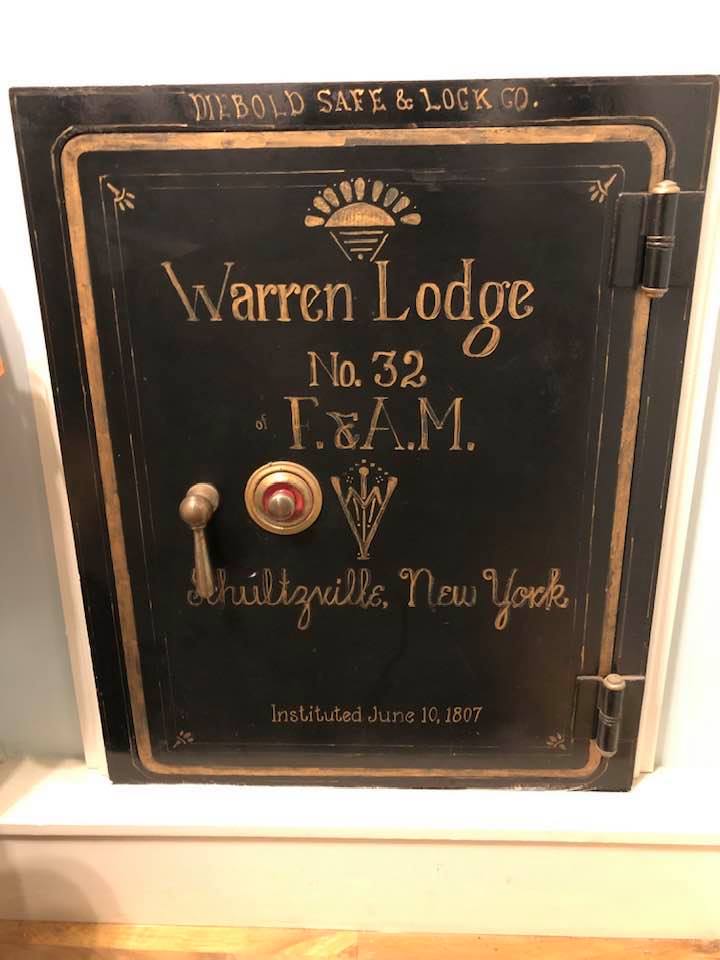
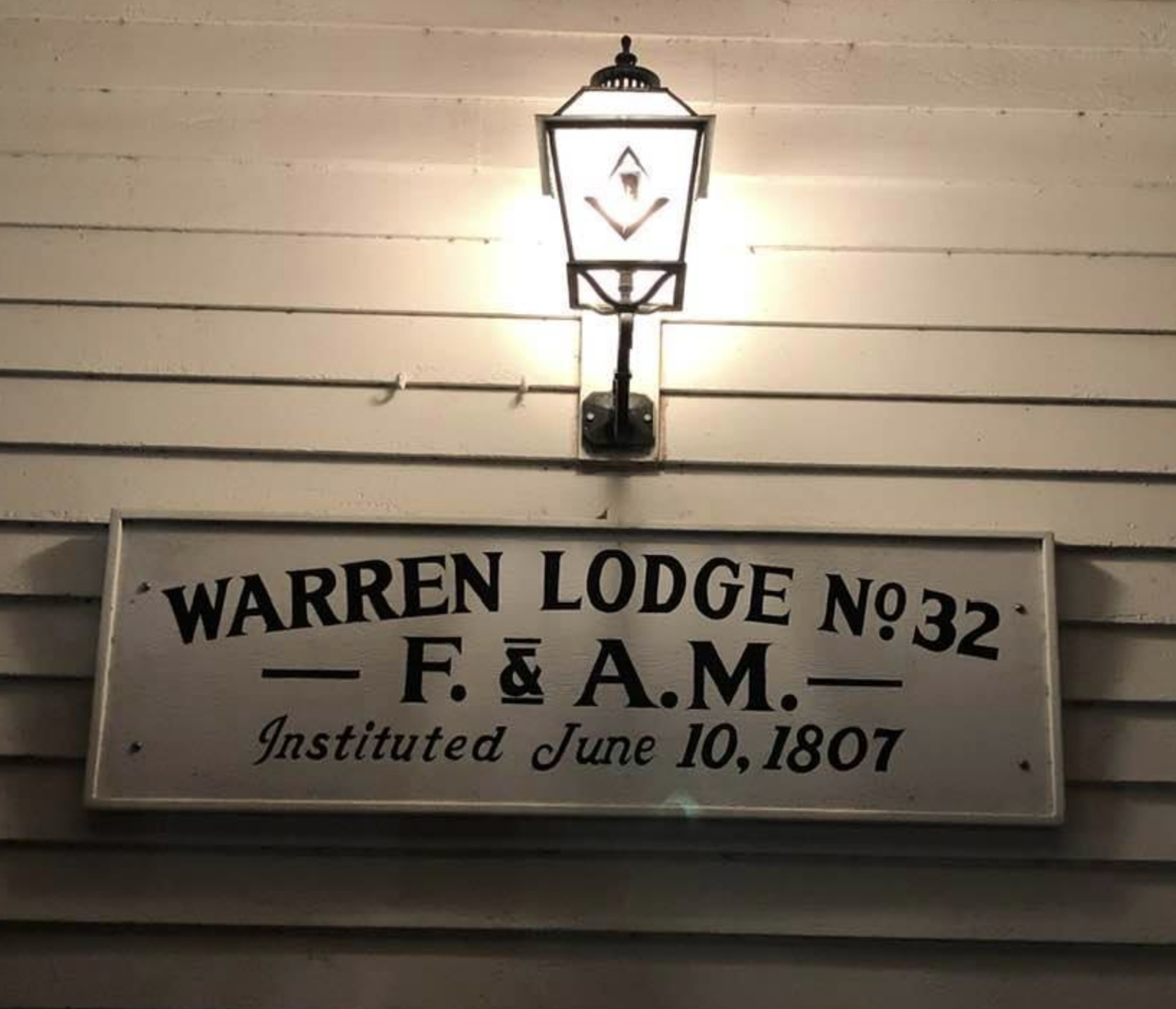
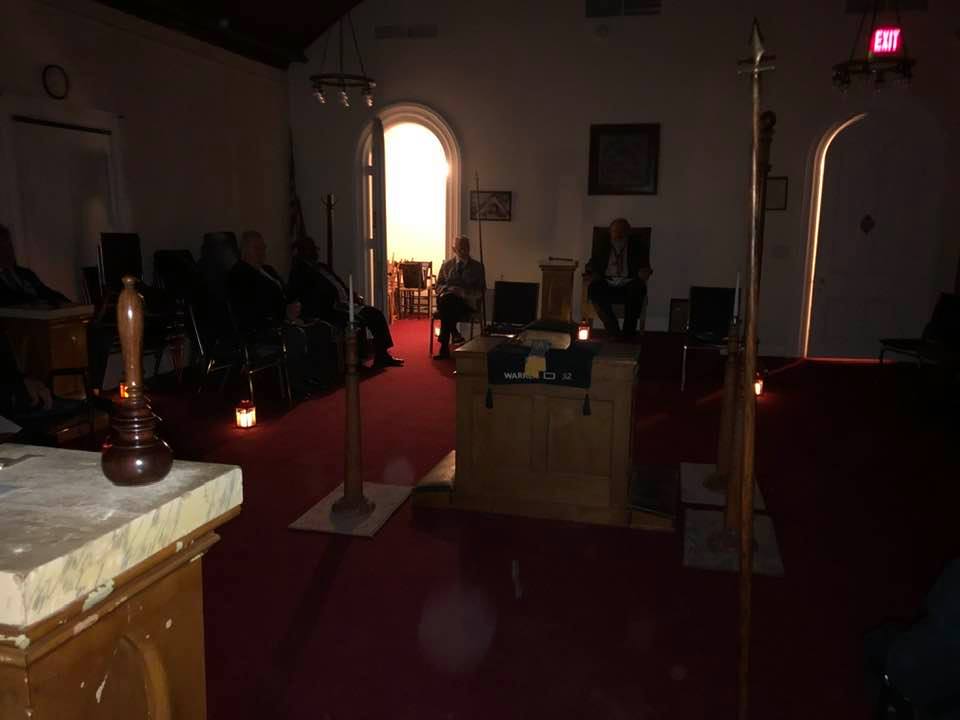
On the evening of April 18, 1775, Paul Revere was summoned by Dr. Joseph Warren of Boston and given the task of riding to Lexington, Massachusetts, with the news that regular troops were about to march into the countryside northwest of Boston. Thirty-two years later, Warren Lodge No. 32, named for Brother and Revolutionary War hero Joseph Warren, was chartered June 10, 1807, by DeWitt Clinton, Grand Master of Masons in New York. It meets in Rhinebeck, New York. Aside from a noteworthy connection to the American Revolution, there is another unique feature that sets Warren Lodge #32 apart in New York State: the Lodge meeting dates are on a lunar schedule. Warren Lodge opens by lantern light, setting its monthly meeting date as the Thursdays before every full moon, rather than on a set calendar day.

The first mention of Moon Lodges can be found in the Cooke Manuscript of 1410, one of the oldest documents belonging to the Masonic Craft. In the United States, Moon Lodges were first noted in colonial times around 1717 to be operating in Philadelphia, Boston, and Tennessee. During the 18th century, when brothers were required to travel to Lodge by foot, horseback, or buggy, a Full Moon assured illumination for the lonely and desolate miles. Masons at that time would travel 8-10 miles or more and were unable to make the long trip home at night and would be supplied lodging by a fellow brother, leaving after breakfast to return home the next morning.

Today, there are roughly 129 moon lodges in America, 14 of which are in Pennslyvania. Texas has the most with 19. Warren Lodge #32 is the last Moon Lodge in the State of New York.

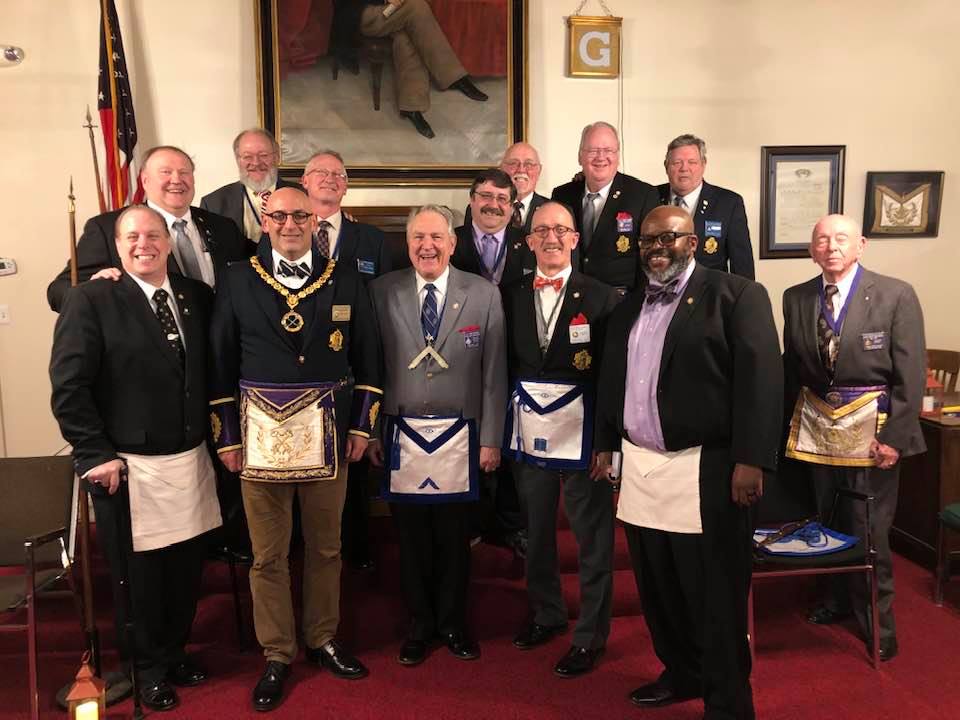
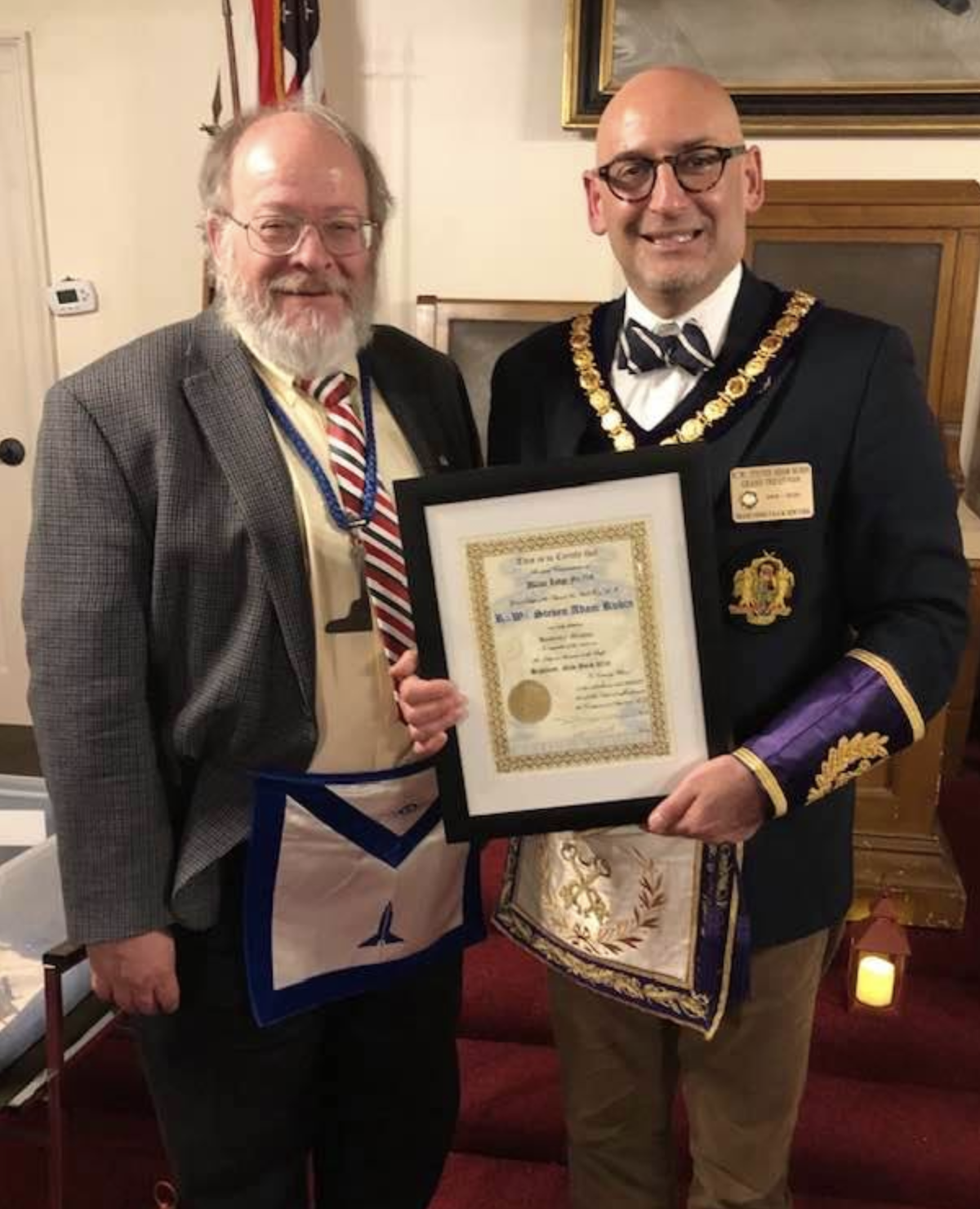
I recently had the honor of attending a Moon Lodge and was equally proud to affiliate with Warren Lodge #32. Below are some of my photographs from the evening.

RW Steven Adam Rubin
Deputy Grand Master of the Grand Lodge of the State of New York
Publisher, Craftsmen Online
Affiliate Member, Warren Lodge #32, the last Moon Lodge in New York State

RW Steven Adam Rubin