The Tree of Life

The Tree of Life

MASONIC EDUCATION

The Tree of Life

How Can We Liberate The Christ Within?

The story of Jesus according to the Qabbalist can be interpreted from the Tree of Life. The greatest story ever told can be a fundamental myth of spiritual liberation. Many theologians took this story literally instead of understanding that it’s all symbolic. Explaining the story using the Tree can unlock many mysteries.

Tiphareth:

On the Tree of Life “Tiphareth” (The Sixth Sephirah), that is on the Middle Sphere of the Tree, represents the Christ Consciousness, it is where the “Ego” of man resides, seated in the “Hearts of Men”. It is the attainment of Christ consciousness which Jesus of Nazareth attained himself.

The Christ Child:

The story of his infancy is also symbolic, especially his fleeing to Egypt. It is a story or a journey we all take in life. The Theologians have a hard time believing the mythical story of Jesus is symbolic, they don’t believe nor care to understand that baby Jesus is a mythical tale of a “Christ in child”. The Three Wise Men or Magi knew the “Christ” (Redeemer) had been born in the material form of Jesus who was conceived in Bethlehem. The question is “Who were these Three Wise men?”

Chokmah:

Looking in the Tree of Life the second Sephirah “Chokmah” which means “Wisdom” is the Three Wise Men, the messengers of the Divine Father. Notice “Magus or Magi” is a grade obtained in the Mystery Schools, it is also said they came from the “East,” which tells us they were members of a Priestly Order. The term king or in Hebrew “Melek” is a reference sometimes to “Tiphareth.” When the Wise men saw the Star of the East, they are referring to the Sphere of “Chokmah,” according to the Qabbalist it is where the “Zodiac” and the Stars reside. This has been related to the Star of the East. Sephirah is truly the Divine father of “Tiphareth” the Christ Consciousness, the Son of the sun.

Binah:

When the Wise Men came to Bethlehem (House of Bread), they saw Mary the Mother of Jesus with him. The term “Mary” means “bitter” or “sea,” in Latin “Maria” means “Sea.” Mary is associated with the Sephirah “Binah,” the Divine Mother which means “Understanding.”

Yesod:

Joseph the Father of Jesus is associated with the Sephirah “Yesod,” which is Foundation. This sphere is where the subconscious mind dreams, as well as, where the reproductive organs reside. In the story of Joseph, he has a dream and takes the family to Egypt, by fleeing to Egypt he is symbolically restricting the habit of mind.

MalKuth:

Egypt means “Straightens or Confined,” and it is located in the Sephirath. “MalKuth,” in the lower world of Yesod. Also, to the Gnostics of Egypt, Jesus meant “Body of Ignorance.” Joseph (Yesod) the Father of Jesus receives a message from the Angels “Chokmah” (Wisdom) through the super-subconscious mind in “Yesod,” which is sometimes depicted as Feminine although, the story is about a male figure. Yesod also represents the generative functions. Joseph (Yesod) brings the Divine Mother “Binah” and the Christ Consciousness “Tipareth” into the physical, manifested world of Egypt (Malkuth), to escape from Herod.

Herod:

When Jesus left Egypt, Herod already died, meaning Chokmah or the Divine Father of Tiphareth (The Christ within) calls his son out of Egypt “MalKuth” (The Physical Plane). The Mythical Story of Herod esoterically is the negative side of the false ego of “Tiphareth,” the Negative personality or the false notion of will.

The Christ Journey:

We can learn from this story and the symbolism, as it represents the Christ journey within. The journey to Egypt represents our first conscious reaction, the key is to destroy the infant Christos within us. Remember the flight to Egypt is our Inner false ego (Herod), we must destroy it and listen to our superconsciousness, represented by the angels (Chokmah).

If we meditate on this story it can be very rewarding, Jesus (Tipareth) or Yesheshuah literally means “He who Liberates.”

Written by Bro. Rene J. Perez
Marshal, George Washington #285
Manhattan, New York

Oriental Shrine

Oriental Shrine

MASONIC BODIES

The Oriental Shrine

NEW YORK STATE’S MOST
NORTHERN SHRINE TEMPLE

Hello again, my Brothers!

I am a member of many concordant bodies, one of which is the Shrine. I am a member of Cyprus and Oriental Shrine Temples. I would like to give Craftsmen followers a little more info on one of New York State’s most northern Shrine Temples. Brothers Jeffery Lindstrand and Byron Moak have provided me with a fantastic glimpse into how Oriental started and some notable/historical members of this great Temple. To be transparent — they helped write most of what is below. I must give credit where credit is due!

Historical Photo of Shriners

The Oriental Shrine Temple was founded on February 21, 1877, with a meeting presided over by Illustrious Noble Jesse B. Anthony. He was at that time Grand Potentate by virtue of a Dispensation dated February 7, 1877, issued by the Imperial Grand Council of the Ancient Arabic Order of the Nobles of the Mystic Shrine (the original name of the Shriners). Grand Potentate Anthony declared Oriental Temple duly organized and in order for the transaction of business. A second meeting was held three days later, and nine names were proposed and accepted for membership. Each member paid their dues of one dollar to join. From these humble beginnings, Oriental Shrine Temple has continued to thrive for 144 years.

In March 1942, during World War II, a unique Ceremonial was held. Oriental Temple named General Douglas MacArthur an honorary member of the Temple. He was sent his honorary membership along with a special telegram and a special resolution. On April 29, 1950, Oriental and Cyprus Temple jointly held the Harold Lloyd Ceremonial. Lloyd was a world-famous actor and comedian. Brother Lloyd was best known for his appearance in silent comedy films. He held his own with the likes of Charlie Chaplin and Buster Keaton. He was also the Imperial Potentate at that time and was making an official visit to the area. That day 65 novices were initiated at the Troy Masonic Temple. A Parade was then held from City Hall to the Washington Avenue Armory for an evening program. During that program, Illustrious Potentate Lloyd was made an honorary member of the Oriental Temple.

Oriental celebrated its 100th Anniversary on May 28, 1977, at the Lake Placid Club with 600 guests and 75 novices. Representatives from 12 other Temples attended and marched in a parade through the town.

The Oriental Shrine Temple of today looks very different than it did in the 60s and 70s. Membership is down to about 300 members, which reflects the overall decline in Masons over that time. This decline in members did not mean that there were fewer activities. Oriental Shrine has Masons from Troy to Vermont to the Canadian border and most of the Adirondacks. They now meet in a building at 75 Water Plant Road, about 4 miles from Uncle Sam’s gravesite in Troy’s historic Oakwood Cemetery. They raise thousands of dollars for the Hospitals.

Oriental is also very active in fundraising. They sell t-shirts at the Annual Lake George Polar Plunge on New Year’s day (profits go to Springfield Hospital), host a Vidalia Onions sale in the spring, conduct a community-wide Basket Raffle in June as well as participate in many other community events. They keep an active social media presence and proudly display their Fez wherever it is appropriate. You will frequently see Shriners during the Summer concerts at the Saratoga Performing Arts Center.

Members of the Oriental Shrine

Oriental has a very active Patient Transportation Unit. Over the past few years, the volunteer Shriner drivers and riders have taken between 60-82 trips per year to Shriner’s Hospitals (trips were paused during the COVID19 pandemic for safety reasons). The brothers that help with the transportation are called Shepherds. They provide safe transport to the hospitals for the children/parents — one more way Shriners help give back to society.

The most popular public event for the Oriental Shriners is their Annual Shriners Circus. Each year during the summer, Oriental sponsors a professional Circus to come to the area and hold several shows at various locations. There are usually 5-6 days of shows with 2 or more shows on most days. These shows feature Shriners handing out clown noses, coloring books, and programs for all attendees. Additionally, Keystone Kops and Clowns usually assist and entertain attendees even before they enter the Big Top. This is always a great time for both young and older fans!

If you are already a Shriner, you know how much fun we have and how much valuable charity work we do for the Shriners Hospitals for Children. If you are a Mason, but not a Shriner, WHY NOT??? It is easy to join! Just contact any Shriner or sign up online. You will be glad you did! And if you know of any child who might need treatment at one of the Shriner Medical Centers, contact us at the Temple or call 800-237-5055.

I hope you have enjoyed this little look inside Oriental Shrine. If you ever have a question about how to join or how to get a child in need to the hospital, please feel free to contact me directly. Again, a BIG thank you to Brothers Jeffery and Bryon for their help with this article!

Written by RW Anthony Prizzia
Adonai Lodge #718
Member of Cyprus Shrine, Oriental Shrine, Ulster County Shrine Club, Valley of Albany A.A.S.R, Poughkeepsie Chapter 172, Poughkeepsie Commandery 43, Royal Order of Scotland.

Masonic Aprons, A Marriage of Art and Freemasonry

Masonic Aprons, A Marriage of Art and Freemasonry

MASONIC ART

Masonic Aprons

A Marriage of Art and Freemasonry

One of the most beautiful and inspiring aspects of the Craft is the Masonic apron. The inspiration does not exclusively lie in the meanings of symbols. Masonic aprons, an essential and most meaningful component of Freemasonry, have not yet found their deserved place in the world of art and collectible artifacts. Generally speaking, Masonic aprons are appreciated mainly by members for their value in ritual or use in Lodge functions. However, such an essential aspect of the Craft is not yet receiving the appreciation it deserves. Masonic museums and libraries have beautiful collections of aprons.

The Badge of Military Merit

From its inception, art has been integrated into every visual within Freemasonry. However, after the Second World War, as members began to dwindle, so did Masonry’s integration of art. What follows here is a brief history of the Masonic apron, the techniques employed, and the type of artists who created these beautiful and meaningful artifacts of Freemasonry. Throughout the years, the techniques used in creating Masonic aprons have encompassed painting, embroidery, and engraving. The types of aprons have also ranged from folk art, often created by self-taught painters, to those aprons made by accomplished artists.

Pictured: PHOTO OF ROYAL ARCH MASON 1850’s-1860’s
Judging by the photo, his apron and baldric are both embroidered.

Handpainted

Hand painting Masonic symbols on aprons was the initial technique used for decorating aprons during the 18th century. Incidentally, the painted aprons are my favorites. Artists used water-based paints in rendering their designs. On occasion, gold leaf would be added. The surface material would be either silk or leather. Silk aprons often consisted of three individual layers. Underneath, one might find burlap to ensure sturdiness. Finally, the backside would get a soft lining material to maintain a consistent presence on the front and back. Sometimes other materials, such as linen or cotton, were used to paint on, but they would be the exception. There were also two-sided aprons that featured imagery on both sides.

A classic example of Masonic Folk Art. Probably dating back to the 1840s-50s, this historic Masonic Apron was painted by a woman. We know this because her business card was attached to the back of the apron. She was most probably self-taught but based on her business card, she was taking on commissions. The lady certainly had some understanding of the subject matter. There is some speculation that the artist might have been an ancestor of President Harry Truman, a prominent mason himself. The flap here is purely decorative, as in the tradition of many of the oldest aprons. The apron is silk. The symbols were first outlined in pencil and then colored in with watercolor.

AN EARLY APRON PAINTED BY A WOMAN

AN EXPRESSIVE PAINTED APRON 1790’s-1800’s

Dating to circa the 1790s-1800s, this expressive historic apron features both depth of color and great style. The colors display an intensity that is quite impressive The images are beautifully rendered with fine use of light and shadow. The subtle sophistication of technique and design sets this apron apart from the previous folk art examples, all of which point to this being the work of an experienced artist. Based on the strength of the colors, one might even mistake them for oil paint, although the artist may have used tempera which is a water-based medium. The decorative fringes and trim are metallic silver. The apron is triple-layered. The front is silk, reinforced underneath by burlap material with a lining on the backside. The apron might be of European origin.

Methods for painting the aprons differed. Many artists first penciled in an outline of the composition, which would be colored in with paint. Some began by laying down the imagery by use of stenciled designs. Yet, other artists felt secure enough to render their imagery completely free-handed. Apron designs were not yet standardized in the early days, meaning that no two aprons were identical (unless a copy was made).

Throughout the years, the aprons’ flaps changed and evolved, as did the shapes of the aprons themselves. The flaps on the earliest aprons were mainly symbolic rather than functional. Trim was used to create the illusion of a flap. It could not be lifted. In due time, flaps were made to be useful. Underneath could be inscriptions, initiation histories, or the craftsmen’s logo, or left untouched. As to the shape of the aprons, initially, many aprons were rounded, and some were rectangular. The rounded aprons eventually became less popular, and the rectangular shape became prevalent. Some triangular aprons are still in use today.

SCOTTISH RITE APRON BY FEMALE REGALIA MAKER

Over the course of the 19th century, painted aprons began to gradually fizzle out. Subsequently, the engraved ones came into prominence. However, the painted aprons never disappeared from use entirely. Even during the early 20th century, there were some lodges that required aprons with painted designs. And here we come to Miss Rose Lipp of Boston, the owner of a company that manufactured and sold all manner of Masonic and other fraternal society regalia and swords. Her employees also included artists who painted aprons on special commission. This circa early 1900s triangular Scottish Rite 22nd Degree apron is a Rose Lipp creation. It appears to be painted on leather. In spite of the relative simplicity of execution, we would not consider this to be folk art.

This is a very beautiful early piece. While deceptively “folksy”, it was most certainly painted by a trained artist with the aim of maintaining a spirit of simplicity in execution. The use of color is striking. There is both subtlety and strength here. Take note of the dramatic shadow effect behind the beams of light surrounding the All-Seeing Eye. Then there is a fine delicacy in the blending of color, most noticeable within the blues and greens. This apron includes the use of gold leaf. The material is very delicate silk. The flap is purely symbolic and cannot be lifted. The borders consist of three elements; two silk ribbons and outer fringes.

PAINTED APRON 1850’s-60’s

ELABORATE SYMBOLIC COMPOSITION, PAINTED APRON

Here we see the extent of freedom artists often enjoyed when creating aprons. This 19th-century apron features an elaborate composition comprised of a great many profound icons. The color scheme is vibrant and lyrical. The symbolic design goes right up to the borders. The piece is most inspiring. It is important to appreciate how the prior absence of rigid standardization of design allowed artists to better convey the beauty and spirit of the Craft.

The Odd Fellows, more than any other fraternal order or so-called “secret society” was the closest in spirit and culture to Freemasonry. One could call it a child of the Craft. Like Masonry, the Odd Fellows originated in Europe. In their heyday, it is believed that almost three-quarters of Odd Fellows membership consisted of Masons. Dual membership in the two organizations was very common. This magnificent circa 1850’s Odd Fellows apron was painted on leather. The influence of Freemasonry is obvious. The use of symbolic aprons by countless numbers of subsequent groups would never have happened had it not been for Freemasonry.

ODD FELLOWS PAINTED 1850’s APRON

PAINTED APRON MADE BY GRAND LECTURER OF NEW YORK

This circa 1840s-1850s painted Royal Arch apron was made by Bro. BW. H. Drew, Grand Lecturer of the Grand Lodge of Free & Accepted Masons of the State of New York. At the time, Bro. Drew operated a very small Masonic and Odd Fellows Regalia company that specialized in both customized and manufactured regalia. Whether Bro. Drew himself painted this apron or had an artist in his employ make it for him, we may never know. But it is clear that an accomplished artist was the creator. The flap in this case is functional. Underneath it, one finds Bro. BW. H. Drew’s logo. Exactly how many or few or any other of his creations have survived these many years is anybody’s guess. This is the only one I have thus far seen.

Engraved

These are often just as remarkable in their beauty as are the painted examples. Rarely is there anything overtly “primitive” looking about them. Engraved aprons were known for their classical and sophisticated appearances. For the most part, the artist who designed the original composition was not the person who would eventually print the engraved imagery on the apron. Processes varied. The most direct technique was where the artist himself would engrave the metal plate. Even in that case, the artist probably did not print the image. The task of printing would be relegated to someone else. Many engravers were also printers, but not all. In some cases, the artist would draw the design on paper to be transferred by a professional engraver onto a metal plate for printing. Then a printer did the printing. The great 19th-century French illustrator Gustave Doré, for example, never engraved his images. He created them as a drawing to be produced by an engraver in the printing process.

DYNAMIC ENGRAVED 19th CENTURY APRON ON SILK

In the photo above, the artwork on this early 19th-century apron concerns itself more with overall form than with particular details. The result is a powerful composition comprised of iconography rendered on glowing white silk with black ink. The effect is quite dramatic. Unlike painted aprons, it is more common to find a discreetly placed artist’s signature on some engraved aprons. A printer’s logo often appears on the backside, but on occasion also under a flap. All parties, artists, engravers, and printers were masters of their Craft.

ENGRAVED SQUARE AND COMPASS APRON by POLLARD

Early engraved aprons could be printed on silk or cloth surfaces and only occasionally on leather. This masterfully engraved circa 1830’s apron was made by the great Boston engraver and maker of regalia Bro. Abner W. Pollard. Stylistically, this piece focuses on powerful renderings of the Square and Compass and All-Seeing Eye. Abner W. Pollard was both a Freemason and an Odd Fellow. He also served as a City Councilman. As a Mason, Bro. Pollard belonged to the Scottish and York Rites. He held office in the Royal Arch and the Knight Templars. Bro. Pollard’s son eventually inherited the business.

Embroidered

Never underestimate the significance of embroidered aprons. Unlike the engraved versions and more like the painted ones, embroidered aprons can be highly ornate and intricately detailed. Still, they can also show the charmingly quaint qualities of folk art. European embroidered aprons are particularly masterful. British Freemasonry, for example, is well known for exquisitely ornate embroidered Scottish Rite aprons. Although these three techniques: painting, engraving, and embroidery, were used independently, on rare occasions, all three methods were used together. At times, jewels were added.

EMBROIDERED FRENCH 1780’s-90’s APRON

Interpretations of Masonic symbolism have varied according to country or jurisdiction. There are also symbols that are not used universally in Masonry. And then there are many symbols that once appeared on older aprons that have long since been discontinued. The core of this unique circa 1780’s-1790’s apron from France was created through the imaginative use of embroidery. The iconography is fabulous. Do take note of the picturesque imagery, a bridge overlooking a river with three skulls, a uniformed and faceless golden gladiator, eagle, and the triangle with Deity symbolism. I myself have seen only a few aprons bearing this particular design. All were in European collections and probably very rare.

This 19th-century apron has integrated several techniques. First came the engraved design. Subtle color paint and applied gold leaf were then added to give the apron a stronger presence.

MIXED TECHNIQUES APRON

As for the artists themselves, some were Masons while others were not. Most were probably men, but more than a few were women. We can presume that those women who created these aprons were either married to Masons or were somehow related. Considering the solid esoteric symbolism portrayed, those gifted women must have had some knowledge of what they were painting. Perhaps their husbands played a little loose with some “secrets” when it came down to getting an apron made.

There were essentially two types of artists who created Masonic aprons: the self-taught and so-called “folk painter” and the highly skilled, or “professional” artist. The folk artist’s work shows excellent charm and spirit and can even be haunting and surreal. The “professional” artist, who, whether academically trained or self-taught, created work that displayed mastery of technique and a sophisticated style. Unfortunately, whether folk artist or professional, most of their names have been lost to history as relatively few Masonic aprons had signatures.

Masonic aprons, being professionally painted or created by amateur artists, have always been a part of art history from the late 1700’s up through the centuries. Ever since the 1960s, American and European folk art, while for the most part previously neglected, rose to prominence in the mainstream art world as well as in the antique marketplace. For many years now, museums and galleries the world over have mounted extensive exhibitions of artwork labeled as “primitive,” “folk art,” “naïve,” and now also as “outsider art.” The American politician and art collector Nelson Rockefeller was an early collector and promoter of American folk art. Today, there are many prized collections of folk art around the world. No doubt much of Masonic apron art and other of Masonry’s crafts qualify as being folk art. But these fabulous pieces are underrepresented in exhibitions of art, most often completely overlooked or purposely ignored. This is very curious because so many of the world’s prominent historical figures have been Freemasons. Could this under-representation be a residue of the ancient legacy of anti-Masonry? Whatever the case may be, it is time for these beautiful, finely crafted historical works of art to be lauded, displayed, studied, and appreciated for their genuine value as fine art.

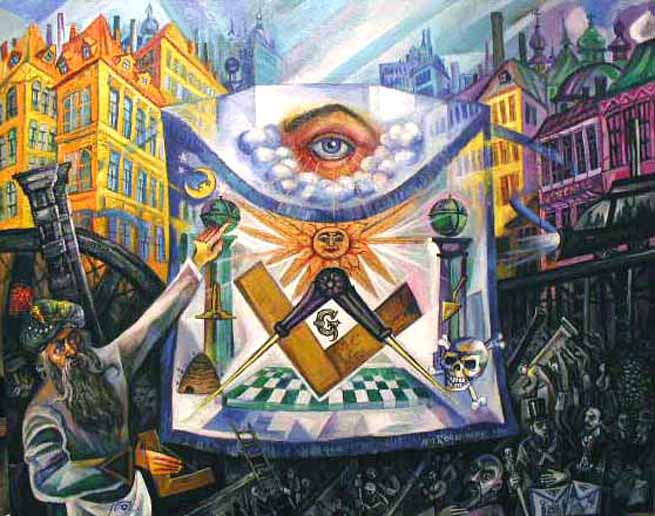
HIRAM’S APRON by ARI ROUSSIMOFF

Being a painter myself, I believe it was the apron’s artistry, which led me down the path to eventually join the Craft. Years later, and very much inspired by the historic aprons, I began to create my aprons. I paint them from my perspective and never copy or imitate the classic ones.

With a more public focus on Masonic aprons and other Masonic artifacts’ beauty and spirit, perhaps they could reach and inspire interested gentlemen, as I once was, to seek their interest in the art, culture, and philosophies of Freemasonry. This path will ultimately lead to a lifelong journey of pursuing the virtues and meaning of our beloved Craft’s historic principles.

Written by Bro. Ari Roussimoff
www.Roussimoff.com
Consolidated Lodge #31 F. & A.M.
Manhattan, New York
Bro Ari Roussimoff

Sight Through Symmetry

Sight Through Symmetry

Seven Liberal Arts and Sciences

Sight Through Symmetry

Capturing nature in photographs to understand our own spiritual being

Hello, once again, my brothers and friends. Over the past 17 years, I have had the honor and pleasure of being asked to be part of many of my Lodge’s investigation committees. The one common concept about Masonry that I bring to all of Adonai Lodge 718’s petitioners is that if you travel if you seek out other Brothers, you will meet people you would never have met not for joining our amazing fraternity. With that said, I would like to introduce VW Erik LaMarca, one very talented Brother to Craftsmen Online’s followers.

Bro. LaMarca is a dual-member and Past Master of Shakespeare Lodge 750 and Kosciuszko Lodge 1085. He also served as an Assistant Grand Lecturer in the First Manhattan District of the Grand Lodge of the State of New York. He is also a Past Monarch of Azim Grotto and a member of Mecca Shriners. Brother Erik is a self-described “photographer of unique, experimental, and abstract art.” He is a self-taught photographer who captured his early images on his iPhone 11. He has evolved into a very talented artist in his craft. Bro. LaMarca is a member of the Solas Studio family who has earned the praise of critics and has been named the Artist of the Week by Abstract Photography and Photographic Artistry Group.

Eric Morabito

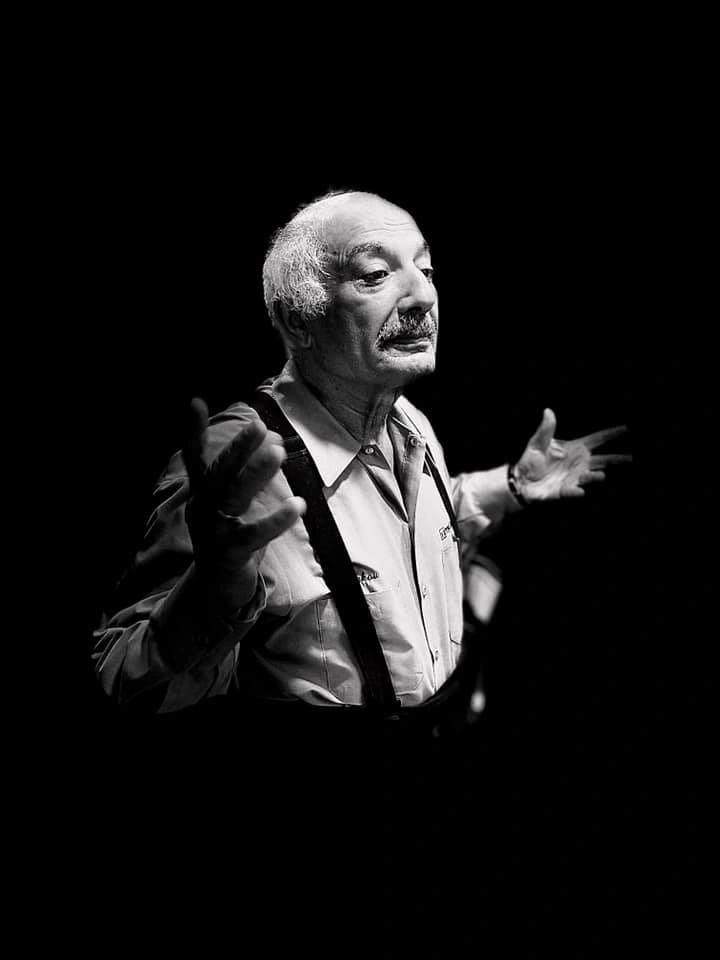
This April, Bro. LaMarca’s art is part of the “Revelation Sight through Symmetry” exhibition at Solas Studio. You can make an appointment to see his display at the Flatiron District studio in Manhattan by clicking here. The more l reviewed his art, the more I was truly inspired by Erik’s eye for symmetry and order. Being an amateur photographer myself, I have always appreciated how much skill goes into finding that perfect moment in time to capture a photograph. One great example of this is a candid shot of one of his co-workers, Yakov, while in the breakroom at his usual vocation.

His ability to capture emotion and convey the feeling/story with his art is some of the best I have seen in my life. His self-discovery of angles, balance, and truth in everyday objects and places comes out of his art in every photo. Since joining Freemasonry, Bro. Erik realizes that darkness is not a negative aspect to fear; it is a starting point at ground level on which to build on. It is a starting point to challenge yourself, dare yourself to subdue your passions, and move to greater light in your everyday life. Erik also realized when you truly realize the above, you can elevate your ambitions and see all the beauty the world has to offer.

I hope that you have enjoyed this glimpse into Bro. Erik LaMarca’s art and I would suggest that if you are in the NYC area, you make an effort to see his gallery showing to support our Brother. I also hope that whether you are a Freemason or not, this article gives you a little inspiration to get out (even if it is only on a digital platform) and meet people from completely different circles of life from your own. People always ask me why I became a Freemason, and I always respond with the same answer. I joined the oldest, largest, and most exclusive fraternity in the world to make the world a little smaller.

Written by WB Anthony Prizzia
Adonai Lodge #718
Member of Cyprus Shrine, Oriental Shrine, Ulster County Shrine Club, Valley of Albany A.A.S.R, Poughkeepsie Chapter 172, Poughkeepsie Commandery 43, Royal Order of Scotland.

The Ezra Ames Meritorious Service Award

The Ezra Ames Meritorious Service Award

ANNOUNCEMENTS

Meritorious Service Award

Craftsmen Online Publisher, RW Steven Adam Rubin receives the Ezra Ames Meritorious Service Award

Ezra Ames Meritorious Service Award

The Ezra Ames Meritorious Service Award

Craftsmen Online wishes to congratulate Grand Treasurer and Craftsmen Online Publisher, RW Steven Adam Rubin, for the presentation by ME Dave Raymond of the Ezra Ames Meritorious Service Award, the highest award of The Grand Chapter State of New York, Royal Arch Masons, in recognition of Bro. and Companion Rubin’s outstanding service to Royal Arch Masonry, as Judge Advocate, Masonic legal adviser of Grand Chapter.

RW Rubin received this award during the Grand Chapter of New York Royal Arch Masons Session on Saturday, March 6, 2021. This hybrid virtual session was held in Utica, New York with an online broadcast via Zoom.

RW Steven Adam Rubin being presented the Ezra Ames Meritorious Service Award at the Grand Chapter of New York session