It’s a Wonderful (Masonic) Life

It’s a Wonderful (Masonic) Life

EDITORIAL

It’s a Wonderful (Masonic) Life

Merry Christmas, you,
wonderful old Building and
Loan. And Merry Christmas
to you, Brother!

I’d like to think that before I was a Mason that I looked at life from multiple angles. Clearly, I was trying. I saw the Holidays as a time, a season, a single episode in the yet to be determined series that would become my life. It wasn’t until I reached my 30s that I really understood the meaning of Christmastime.

I was clicking through the TV guide one Christmas Eve, looking for something to watch during the downtime between putting the kids to bed and before we prepared for Santa’s arrival. My eye caught the title It’s a Wonderful Life. Somehow I had made it this far in life without seeing the Holiday classic. I remember my Dad making a big deal when NBC started airing it in 1994. To me, it was an old black-and-white movie; I preferred 24-hours of The Christmas Story on TBS. Sorry, Dad, I’ll leave the nostalgia to you. But something was different that night. I decided to make the two hours and fifteen-minute commitment with a full bottle of wine.

After all, it was my duty to be sure that the kids were really asleep.

It’s a Wonderful Life is now part of my holiday routine. And every year, when I sit down to watch it, something new in the film gets my attention. How Bedford Falls represents “Everytown, USA.” The bridge scene, where even with the gritty black and white film; in your mind, you can see how deep that water is and imagine how cold it must be. Knowing the hidden pain in George Bailey’s eyes every time something in his life goes wrong. The joy that causes his voice to crack when everyone in town comes to his aid.

Every year, I find a quiet night, start the movie, and enjoy the experience.

This year, Clarence’s line to George, “Each man’s life touches so many other lives. When he isn’t around, he leaves an awful hole, doesn’t he?” caught my ear. It connected a few thoughts. The first is the section of the Fellowcraft degree charge that literally discusses our personal contact with others, the influence we have on those who share our circle. How as Masons, we strive to be charitable, honest, and humble. Whether that is bell ringing for the Salvation Army on a cold, winter night for a few hours, collecting coats for the homeless, shopping for gifts for those less fortunate, serving warm meals in soup kitchens, or making time to connect with those who are alone this time of year — it’s rewarding to know that we have Brothers who give time to make the Holidays merry for those in need.

We realize that our work is to bring light to dark places. And even if I don’t get a chance to meet them or learn the details of their work, these men share the same title of Brother as I do, and that makes us one and the same.
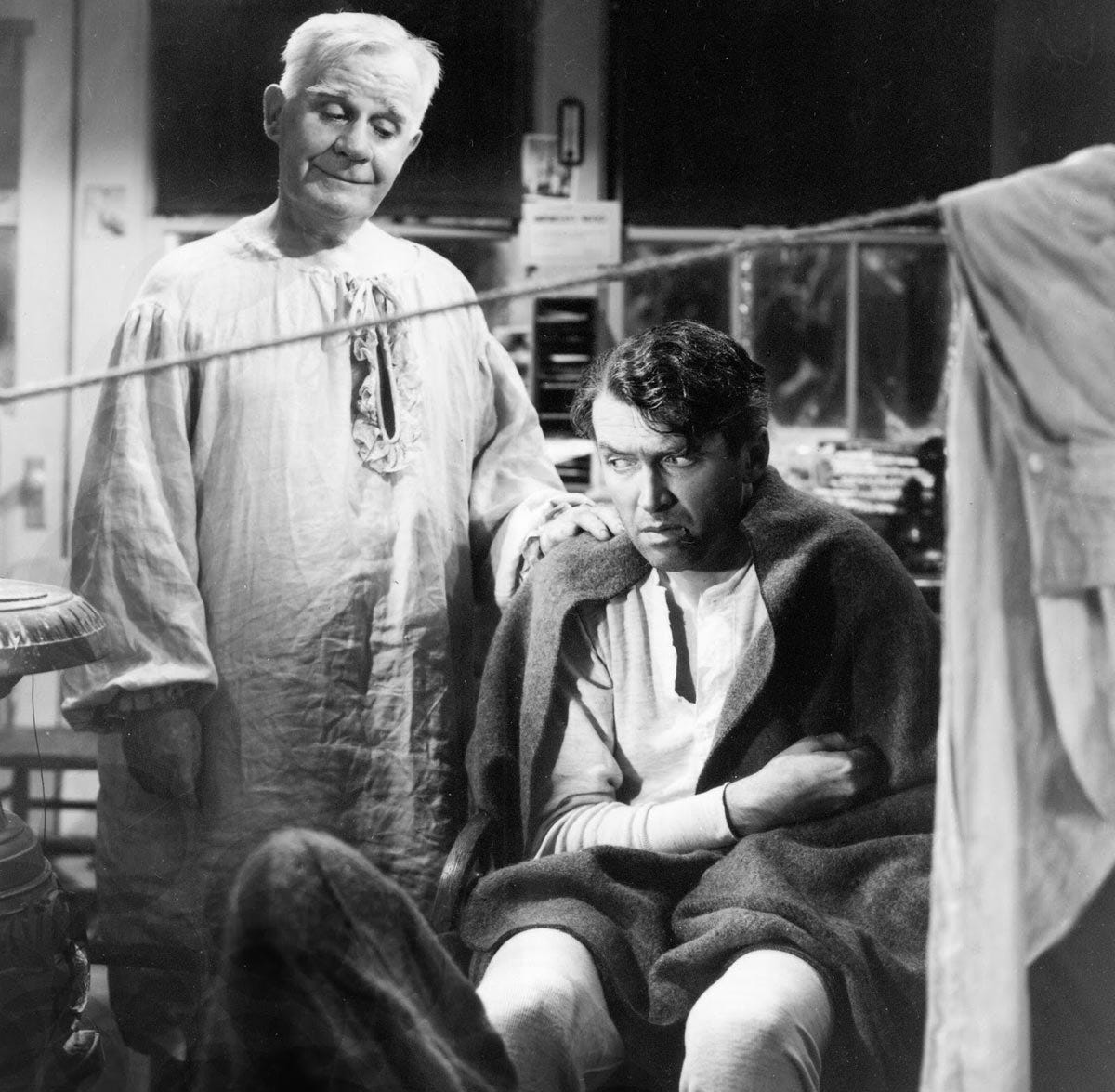
The second part of Clarence’s line almost brought a tear to my eye when I thought of Brothers who have laid down their Working Tools this year. Those men who were pillars in our Lodges as role models and mentors, whose encouraging words or kind smiles made us feel welcome and valued. And while I had visions of my Brothers who have gone to join the Grand Architect of the Universe, I also thought of a Brother who I haven’t seen at a Lodge meeting in a few years.

Work, his family, and caring for his aging mother are all reasons why he hasn’t been able to attend meetings. He also lost the passion for knowledge that could fill a small library because of a disagreement with his Brothers. I still hope that someday, he chooses to put on his dark suit and tie and surprise me at a meeting. A few days after watching the movie, I sent this Brother a text just to see how everything is in his world.

Lying in bed after the movie, I stared up at the dark ceiling above to reflect on this year. I realized that there’s a reason why we love It’s a Wonderful Life: watching George Bailey’s story causes us to examine our own. We choose to gather with our closest family and friends this time of year for a reason. We want to remember this feeling, knowing that years from now, those hugs from grandparents or the sound of giggling kids will be our most precious memories.

Reflecting on the Masonic year has the same effect. Dinners, ritual practices, community service, the raising of new Brothers. Those moments serve as the highlights of our year. While we may know the men we share that time with, we may never truly understand the significance of these shared experiences in their life. This “ripple effect” is a theme I understood throughout the movie. Somehow this year, the mix of new relationships and old memories made a deeper connection to the difference we make as Masons in the lives of those we interact with.

“Remember, no man is a failure who has friends.”

Wherever you are this year, my Brother, I send you the warmest Holiday Greetings. May you continue to bring Light to every life you touch.

Written by RWB Michael Arce
Host of the Craftsmen Online Podcast
Mount Zion Lodge No. 311, Troy, New York
St. John’s Lodge No. 11, Washington, DC

Remembering MW Robert R. Livingston

Remembering MW Robert R. Livingston

FAMOUS FREEMASONS

Remembering MW Robert R. Livingston

From the Declaration of Independence to “The Chancellor.” How Brother Livingston contributed to the benefit of the Craft

On this twenty-seventh day of November in 1746, Brother Robert R. Livingston was born to Robert and Margaret Livingston in New York City, in the British colony of New York. At the age of 15 Brother Livingston began to study at King’s College, now Columbia University. After graduating, he started his career as a lawyer and practiced for a short time until he was pulled into the colonial drive for independence from Britain.

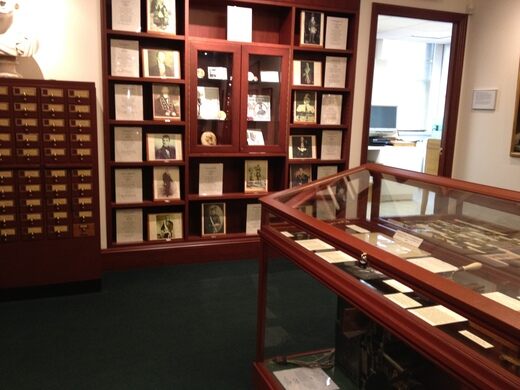
Display cases at the Chancellor Robert R Livingston Masonic Library

For the next sixteen years, Most Worshipful Robert R. Livingston served as Grand Master of the Grand Lodge of Free and Accepted Masons in the State of New York. His influence on New York Masons is obvious, especially with the Chancellor Robert R. Livingston Masonic Library. New York Masons in good standing can freely check out a book from this library from anywhere in the State. You simply need to pay the return shipping. “The Livingston Masonic Library offers seventeen structured Reading Courses designed to provide education and enlightenment in areas of Masonic study and interest.” I am currently enrolled and while some book selections can be dry and perfect to start a good night’s sleep, others are outstanding and can hold your interest for as much time as you have available.

As part of the Committee of Five, Robert R. Livingston to the left of Thomas Jefferson along with Benjamin Franklin, John Adams, and Roger Sherman presents the draft Declaration of Independence to the Second Continental Congress in John Trumbull’s 1817 painting “Declaration of Independence”. Unfortunately, Brother Livingston was called away from Congress to attend to other duties before the document was signed.

After his work on the Declaration of Independence, he became New York State’s Chancellor, the highest-ranking judicial official. Brother Livingston held this position for twenty-four years resulting in his nickname; “The Chancellor”, a name he used in public and within his family due to his father sharing the same name as Robert. As Chancellor of New York Brother Livingston administered the oath of office to our nation’s first President, Brother George Washington. The same Bible Brother Washington used to take his oath is still on display at Federal Masonic Lodge #1 in Washington DC.

In the years following, he served as secretary of foreign affairs. Since he was dealing with the issues of a weak central government outlined by the Articles of Confederation, Brother Livingston became an advocate for a stronger federal system for the Union and a supporter of the United States Constitution.

Brother Livingston strongly supported Thomas Jefferson’s presidency. There is speculation whether Jefferson was actually a Mason. There is some evidence that says he was but little proof exists. Having Brother Livingston’s support suggests (at least to this writer) that Jefferson was a Mason in good standing and if not, he was one in his heart. Under Jefferson’s presidency, Livingston became the Minister of Plenipotentiary (Ambassador) to France (1801-1804). Together with James Monroe, they negotiated the terms of the Louisiana Purchase from Napoleon Bonaparte’s regime. Interestingly, Wilhelm Willink, a wealthy merchant from Amsterdam and investor in the Louisiana Purchase was also an investor in the Holland Land Company. If you own property in Western New York, you will most likely see the Holland Land Company on your deed as the original owner.

During his time in France, Livingston met Robert Fulton. Brother Livingston was able to adapt his prior steam experience with his brother-in-law John Stevens, an engineer, and inventor who constructed the first U.S. steam locomotive to jointly developed the first commercially successful steamboat in 1807. After his retirement from politics and the years following the successful development of the steamboat, Livingston obtained a monopoly on steam navigation in New York. His shipping company began to use the “Clermont” (named after his family’s estate) to carry passengers between New York City and Albany by way of the Hudson River. This 150-mile trip took a record 32 hours. Continuing their success with the “Clermont” Livingston, Fulton, and Nicholas Roosevelt developed a steamboat sturdy and powerful enough to travel up and down the Ohio and Mississippi rivers. The “New Orleans” traveled from Pittsburgh, Pennsylvania to New Orleans, Louisiana, and the Gulf of Mexico coast with several stops between. Due to this successful voyage and being less than ten years from the Louisiana Purchase, trade, transportation, and settlement for America’s heartland were forever changed.

Brother Robert Livingston spent his later years as a founder of the Society for the Promotion of Agriculture, Arts and Manufactures, and spent time with experiments in agriculture and raising sheep. Our Brother laid down his earthly working tools and passed to the celestial Lodge above on February 26, 1813, at the age of 66 from a series of strokes. Brother Robert Livingston is buried at Saint Paul’s Episcopal Church Cemetary, Tivoli, Dutchess County, New York, USA.

Written by WB Todd M. Paterek
Blazing Star Lodge #694 F&AM
East Aurora, NY

Bro. Todd Paterek