The History of the Purple Heart

The History of the Purple Heart

MASONIC HISTORY

The Badge of Military Merit

The connection between the Purple Heart and Freemasonry

The late Brother Audie Murphy is arguably one of the most recognizable World War II veterans. Murphy allegedly falsified documents to get into the US military prior to his 18th birthday. During World War II, the Texas native became one of the most decorated service members, earning every military combat award for valor available from the US Army. These awards included the Medal of Honor and the Purple Heart with two Oak leaf clusters – indicating the award was given three times. Interestingly, of the awards earned by Brother Murphy, the Purple Heart has a connection to Brother George Washington and a connection to New York State and a Grand Lodge of New York property.

The Badge of Military Merit
While the Purple Heart was first awarded in 1932, it is inspired by a much older American award – The Badge of Military Merit. This award is “the figure of a heart in purple cloth, or silk, edged with narrow lace or binding,” sewn onto the left chest of the recipient’s uniform. On August 7, 1782, General George Washington issued a general order to establish The Badge of Military Merit.

The Badge of Military Merit is generally considered the first military decoration issued by the United States and one of the earliest like awards in modern militaries, only given to non-commissioned officers and enlisted men. Surviving records indicate that during the War for American Independence, only four men obtained this award. The first two men to have received this accommodation were honored by General Washington himself.

While the fighting on American soil generally ended with the Siege of Yorktown (September 28 – October 19, 1781), the Treaty of Paris was not signed until September 3, 1783. To ensure American interests were met at the negotiation table, Washington’s Army was kept intact, and he headquartered the post-conflict American Army at Newburgh, NY. While headquartered in Newburgh, Washington quelled the Newburgh Conspiracy and issued the very first Badge of Military Merit. This is why the National Purple Heart Hall of Honor is located in Newburgh today.

On the Third of May 1783, General George Washington presented The Badge of Military Merit to William Brown of the 5th Connecticut Regiment and Elijah Churchill of the 2nd Regiment of Light Dragoons (CT). Washington presented these awards at his headquarters in Newburgh, NY. The following day, General Washington arrived at a residence he had previously stayed for short periods prior — The DeWint House in Tappan. Most New York Masons should perk up when they hear of Washington in Tappan as the Grand Lodge of New York owns the Historic Site at Tappan — also known as the DeWint House.

The DeWint House is the oldest surviving structure in Rockland County and saw multiple visits from Brother George Washington. Washington’s first visit was August 8-24, 1780, while inspecting a redoubt on the Hudson River. Several months later, Washington again stayed at the house from September 28 – October 7, 1780, during the trial of British spy Major John André. He was captured after a meeting with Brother Benedict Arnold, where the two conspired to betray the fortifications at West Point.

Three years later, Washington returned to the home (May 4-8, 1783). This time, Washington stayed at the DeWint House while negotiating British troops’ final withdrawal from New York City. Washington made the house his headquarters the day after awarding the initial Badge of Military Merit to Elijah Churchill and William Brown. Washington’s final visit to the home came just six months later when a snowstorm forced him the seek refuge during his trek from West Point to New York City – on his way to tender his resignation from his position as General of the Army.

One may wonder how this property wound up in the position of the Grand Lodge of New York. In 1932 Grand Master Charles H. Johnson heard that the property was for sale and a potential buyer was likely to tear down the residence so closely connected with Brother George Washington. The Grand Lodge of New York has owned and maintained the property since. The Grand Lodge of New York restored the DeWint House, and in 1966 it was declared both a National Historic Landmark and added to the National Register of Historic Places.

Written by Bro. Nathan Tweedie
Senior Deacon and Historian, Ostego Lodge #138
Junior Warden, Delaware River Lodge #439
Central Leatherstocking District

Remembering MW Robert R. Livingston

Remembering MW Robert R. Livingston

FAMOUS FREEMASONS

Remembering MW Robert R. Livingston

From the Declaration of Independence to “The Chancellor.” How Brother Livingston contributed to the benefit of the Craft

On this twenty-seventh day of November in 1746, Brother Robert R. Livingston was born to Robert and Margaret Livingston in New York City, in the British colony of New York. At the age of 15 Brother Livingston began to study at King’s College, now Columbia University. After graduating, he started his career as a lawyer and practiced for a short time until he was pulled into the colonial drive for independence from Britain.

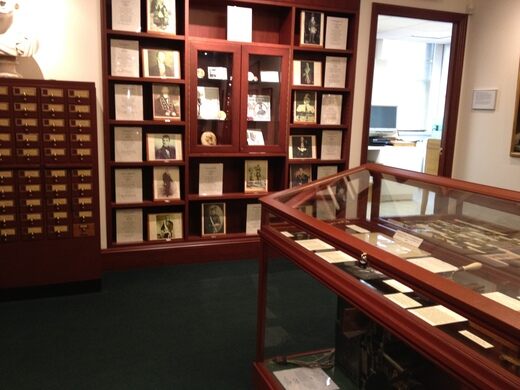
Display cases at the Chancellor Robert R Livingston Masonic Library

For the next sixteen years, Most Worshipful Robert R. Livingston served as Grand Master of the Grand Lodge of Free and Accepted Masons in the State of New York. His influence on New York Masons is obvious, especially with the Chancellor Robert R. Livingston Masonic Library. New York Masons in good standing can freely check out a book from this library from anywhere in the State. You simply need to pay the return shipping. “The Livingston Masonic Library offers seventeen structured Reading Courses designed to provide education and enlightenment in areas of Masonic study and interest.” I am currently enrolled and while some book selections can be dry and perfect to start a good night’s sleep, others are outstanding and can hold your interest for as much time as you have available.

As part of the Committee of Five, Robert R. Livingston to the left of Thomas Jefferson along with Benjamin Franklin, John Adams, and Roger Sherman presents the draft Declaration of Independence to the Second Continental Congress in John Trumbull’s 1817 painting “Declaration of Independence”. Unfortunately, Brother Livingston was called away from Congress to attend to other duties before the document was signed.

After his work on the Declaration of Independence, he became New York State’s Chancellor, the highest-ranking judicial official. Brother Livingston held this position for twenty-four years resulting in his nickname; “The Chancellor”, a name he used in public and within his family due to his father sharing the same name as Robert. As Chancellor of New York Brother Livingston administered the oath of office to our nation’s first President, Brother George Washington. The same Bible Brother Washington used to take his oath is still on display at Federal Masonic Lodge #1 in Washington DC.

In the years following, he served as secretary of foreign affairs. Since he was dealing with the issues of a weak central government outlined by the Articles of Confederation, Brother Livingston became an advocate for a stronger federal system for the Union and a supporter of the United States Constitution.

Brother Livingston strongly supported Thomas Jefferson’s presidency. There is speculation whether Jefferson was actually a Mason. There is some evidence that says he was but little proof exists. Having Brother Livingston’s support suggests (at least to this writer) that Jefferson was a Mason in good standing and if not, he was one in his heart. Under Jefferson’s presidency, Livingston became the Minister of Plenipotentiary (Ambassador) to France (1801-1804). Together with James Monroe, they negotiated the terms of the Louisiana Purchase from Napoleon Bonaparte’s regime. Interestingly, Wilhelm Willink, a wealthy merchant from Amsterdam and investor in the Louisiana Purchase was also an investor in the Holland Land Company. If you own property in Western New York, you will most likely see the Holland Land Company on your deed as the original owner.

During his time in France, Livingston met Robert Fulton. Brother Livingston was able to adapt his prior steam experience with his brother-in-law John Stevens, an engineer, and inventor who constructed the first U.S. steam locomotive to jointly developed the first commercially successful steamboat in 1807. After his retirement from politics and the years following the successful development of the steamboat, Livingston obtained a monopoly on steam navigation in New York. His shipping company began to use the “Clermont” (named after his family’s estate) to carry passengers between New York City and Albany by way of the Hudson River. This 150-mile trip took a record 32 hours. Continuing their success with the “Clermont” Livingston, Fulton, and Nicholas Roosevelt developed a steamboat sturdy and powerful enough to travel up and down the Ohio and Mississippi rivers. The “New Orleans” traveled from Pittsburgh, Pennsylvania to New Orleans, Louisiana, and the Gulf of Mexico coast with several stops between. Due to this successful voyage and being less than ten years from the Louisiana Purchase, trade, transportation, and settlement for America’s heartland were forever changed.

Brother Robert Livingston spent his later years as a founder of the Society for the Promotion of Agriculture, Arts and Manufactures, and spent time with experiments in agriculture and raising sheep. Our Brother laid down his earthly working tools and passed to the celestial Lodge above on February 26, 1813, at the age of 66 from a series of strokes. Brother Robert Livingston is buried at Saint Paul’s Episcopal Church Cemetary, Tivoli, Dutchess County, New York, USA.

Written by WB Todd M. Paterek
Blazing Star Lodge #694 F&AM
East Aurora, NY

Bro. Todd Paterek

Opening and Closing of the Lodge Ritual

Opening and Closing of the Lodge Ritual

MASONIC EDUCATION

Opening and Closing Ritual

THE THREE FUNCTIONS OF CALLING THE MEETING TO ORDER

In this article, we will be looking at what I believe is implied in the opening and closing ritual in terms of our Three-Fold Duty to Deity, Our Brothers, and Ourselves. I will be drawing upon the works of Henry Meacham, Kirk Mcnulty, and Ray Dalio (bibliography will be made available upon request). It is specifically the three distinct functions of the opening, and closing ritual, which I assert call upon our threefold duties, and this point will hopefully become more clear by the conclusion of this writing.

To begin, we must discuss the functions of the Opening and Closing Ritual. I, for the purpose of this article, will point to three main functions, but the astute student of the craft may consider more. However, it is my belief those extra functions, in all honesty, can be traced back to these main three.

The three functions of the Opening and Closing Ritual are Purging the Lodge, Aligning the Officers, and Invocation of Deity. These three functions are evidenced in the ritual itself but are alluded to, if not explicitly stated, in Henry Meacham’s book Our Stations and Places. This work covers a myriad of topics essential for review among both the novice and the veteran. I would go further to say, each of these three functions or actions I trace back to our duty to Deity, Our Brother (or our Neighbor), and ourselves.

To make this connection more vivid, I would like to reference the implied analogy of the lodge or temple and the self, specifically with reference to the constituent officers of the lodge representing component parts of the self. This example is poignantly essayed by McNulty in the Way of the Craftsman, required reading of the Robert Livingston Library course (I highly recommend all brothers take these reading courses). I will not belabor the intricacies of the analogy but suffice it to say the lodge and the self can be viewed as a macrocosm and microcosm of the same thing, the same living breathing entity. You are the lodge; the lodge is you.

So what then is the purge, and what is the Opening and Closing of Lodge? Given this lens, the purge is exactly that first pursuit in seeking to better oneself in freemasonry, Divesting oneself of the vices and superfluities of life. In the material and Macrocosm level of the lodge, we are removing the uninitiated and unworthy person from the lodge. On the individual or microcosm level, we are purging our hearts and minds of thoughts, the spiritual and intellectual constituents of the mind, and targeting for removal those unworthy and unqualified thoughts that do not belong in the self while at the lodge or abroad in the world.

Alignment is a little more obvious in this example. Harmonizing of the officers is analogous to harmonizing the several parts of the self. as the Master, Wardens, and Deacons align for the purpose of conducting the affairs of the lodge, so should the individual align their spirit, conscious, body, inward, and outward awareness to respectively conduct themselves accordingly. Importantly, however, this is not to suggest that these separate individuals are to be tools of the Master, and are to cease to be individuals, neither should the various parts of the self become slaves to the passions of one’s own soul. These several parts should work together in harmony and balance. Preparing to work in harmony is the second functional objective of the Opening and Closing Ritual and it is arguably the support of all institutions, especially this of ours.

Lastly, and I would argue most importantly, the overarching objective of the Opening and Closing Ceremony is the invocation of Deity. It is specifically in this invocation that speaks to me of our threefold duty. The Chaplain’s verbiage is particularly important, in his request of Deity which he asks permission or on behalf of the lodge. He asks that the lodge humbly reflect. Specifically, the object of the lodge’s reflection is the divine order and beauty which reign forever before the GAOTU’s throne. But what I consider most important in this discussion is the nature of reflection in an everyday practical sense on the individual and microcosm level of the lodge which I feel speaks to our threefold duty which we are all charged with upon becoming Masons.

In Ray Dalio’s short animation titled Principals, he discusses success in terms of striving toward goals. He also mentions that it is likely anyone/ everyone will experience problems, weaknesses, and mistakes in trying to achieve those goals. Pain, in his view, is the experience of problems, weaknesses, and mistakes. There is a practical need in his view to meditate or Reflect, on pain. He importantly distinguishes the act of feeling and re-experiencing pain, from Reflection. In his view reflection is the evaluation of how to deal with the real limitations of weakness and mistakes in overcoming problems. This is how we achieve success. He says explicitly that a natural response to pain is inflation of ego. and by reflection, we can dissolve the persistence ego, and face reality. ‘Why did this failure happen when faced with these problems, weaknesses, and mistakes?’ we should ask. Through honest and real reflection on what occurred, we will be equipped with the correct responses and overcome these obstacles as they occur in the future to achieve our goals. In doing so we will unlock not only our goals but tools to realistically deal with problems we are faced with and will more than likely be challenged with again. By knowing our limitations and finding solutions around them and eliminating the ego, success is possible.

Success – That Order and Beauty which Reign forever before His throne.

So, what is our goal? What is our purpose that we are setting out to achieve, purging out what is unworthy, aligning ourselves, physically and spiritually, and invoking the aid of deity via reflection upon his grace? We aim to make ourselves better men. To humble ourselves before the chief good, honoring his name, and imploring his aid, to do good to our brothers, acting upon the square and doing unto them as we would wish they should do on to us, and to ourselves, in never debasing ourselves or our professions by intemperance; zealous adherence to the principals which distinguish us from the common or profane man, these are the goals we are striving towards. May we humbly reflect upon our pains in their pursuit.

So mote it be.

Submitted by W.M. Galen Kaback
Advance Service Mizpah Lodge #586, Long Island City, NY

WB Galen Kaback