Masonic Thanksgiving

Masonic Thanksgiving

MASONIC HISTORY

A DAY OF THANKS-GIVING

How Freemasons should mark
this day of Thanksgiving

While President Lincoln declared Thanksgiving a national holiday to be held on the last Thursday of the month of November, it may not surprise Masons to learn that Bro. George Washington was the first to issue a Presidential Proclamation in 1789. As President, Bro. Washington at the request of Congress, proclaimed November 26, 1789, as a day of “public thanks-giving” to reflect on the creation of the United States and US Constitution.

The striking difference between the Presidents’ proclamations, written almost 75 years apart, is the tone. Washington’s proclamation has a celebratory feel mixed with a sense of obligation, “…with grateful hearts the many and signal favors of Almighty God, especially by affording them an opportunity peaceably to establish a form of government for their safety and happiness.” This contrasts Lincoln’s proclamation which contains overtones of grief due to the Civil War, looking to God for care and counsel, “…with humble penitence for our national perverseness and disobedience, commend to His tender care all those who have become widows, orphans, mourners or sufferers in the lamentable civil strife in which we are unavoidably engaged, and fervently implore the interposition of the Almighty Hand to heal the wounds of the nation…”.

As we prepare to gather with family, loved ones, and friends let us pause to reflect and appreciate the many blessings and positive moments we have benefited from this year. And let us celebrate the happiness and joy our loved ones have experienced as well. Masonically, Thanksgiving should serve as a day to mark this moment in our travel across the level of time by giving thanks to the Grand Architect for providing the opportunity for guidance and inspiration throughout our journey.

The Working Group at Craftsmen Online wish you and yours a safe and Happy Thanksgiving!

Written by:
Bro. Michael Arce
Co-Founder and Editor-in-Chief, Craftsmen Online

Diversity of Thought

Diversity of Thought

MASONIC MENTORING

Diversity of Thought

How Freemasonry encourages collaboration and the exchange of personal viewpoints

Freemasonry is a social activity. I am a member of a Puerto Rican Lodge. I could seldom visit, so I joined the Liverpool Lodge. Then, I felt a need to meet District Brothers from other Lodges. I joined the District Deputy Grand Master’s family, visiting all Lodges in my District, and participating in Master Wardens and Deacons (MWD) Bimonthly Meetings, where I met and befriended many Brothers more. I then joined the Scottish Rite, where I befriended even more Brethren, from Masonic Districts adjacent to Onondaga.

My objective was much more than just social. The interaction with so many Brothers helped me grow Masonically, and provided many new ideas, some of which I have aired in this column.

Associations have at least two values: first, to fulfill the purpose for which they were created; then to put people in contact. MWD’s were created to help District Lodges coordinate their work and instruct leaders about issues of importance and concern to our Institution. Collaborating and exchanging views and information with others expands old ideas, fosters new ones and develops efficient ways to enhance joint programs. These are, possibly, MWDs most powerful functions.

Currently, our country is extensively divided on several central issues. The level of discord has become toxic. The Media is similarly divided into partisan lines; audiences join those outlets that reinforce their views. Organizations, where both sides of an issue are examined with balance and moderation are rare. Partisan deliberations of commentators and analysts, exacerbate things.

We believe Freemasonry can contribute two key components to help diffuse tension. First, it can provide information about the topics in question. Secondly, and perhaps more important yet, to examine them in a Tolerant atmosphere, showing that one can respectfully and fairly disagree on any subject. In these difficult times, this would be a great contribution to reduce friction.

Let’s provide an illustrative example: the voting system controversy. What is it? What does it pursue? What are its limitations? What alternative voting systems are there? Many discrepancies stem from a lack of basic understanding or of knowledge, of key facts involved in the problem.

This Mentor, strives to fulfill Love of Country and Service to Humanity obligations, while keeping Freemasonry’s rule not to conduct partisan politics. We believe that such can be achieved by carefully examining challenging elements of a conflicting issue, that often create tension among the contenders, without taking sides in the dispute.

For example, we can organize a panel with two Brothers that support one point of view, and two that support another one, plus a Moderator. Then we open the debate to the public. To attain success, the project needs Brothers from different District Lodges to help with event attendance and advertisement. Said project would first need to be discussed and planned in the MWDs.

What would Freemasonry gain from all this? People would notice our efforts to help lower the toxic levels of partisan disagreements, thus gaining in public appreciation for our labors.

Such approach is not new to Freemasonry. For example, the Grand Lodge of Cuba stated, in 1936, also during a very heated political period, the following opinion: Freemasonry does not intend to stop the struggle between ideologies, but to help create a climate where everyone can defend his principles using reason, and achieve success based upon the merits of his ideas.

Bro. Jorge L. Romeu
Onondaga District Mentoring Chair

Why Your Lodge Should Do A Joint Degree

Why Your Lodge Should Do A Joint Degree

Why Your Lodge Should Do A Joint Degree

The case for providing the best experience for candidates and members

Stop me if you’ve experienced this… your lodge is hosting a degree and the only thing secured is the candidate’s name. You’re scrambling to fill the chairs. One Brother with an important role only knows half of his part, really, he just started learning it after having weeks to prepare. Its degree night and another Brother, the who only seems to show up on degree night (we all know that guy), is asking out loud, “What’s for dinner? Who is doing the prompting? Forget about practice or rehearsals, you can barely get a team assembled for degree night. Does this sound familiar?

Many years ago, my district, the Old 17th (Albany, Rensselaer, Schenectady and Troy), floated the idea of creating a database of Brothers who can perform parts of our ritual. While there are lodges who have members who can fill every degree role, some feature a bench so deep with alternates and backups — just in case. For many lodges that need help filling open parts and positions, the thought was, if we compiled a list of “specialists” who could be contacted in advance, this resource would help the lodge coordinating the degree. Bringing in help is one way of pulling a degree together. However, the other idea also provides the best experience for the candidates and members of the lodge. A joint degree showcases the Masonic principle of how the best work is done together, in harmony.

A Joint Degree

I had the pleasure and honor of attending and participating in a Joint Degree featuring SIX candidates from THREE Lodges in TWO districts: Van Rensselaer #87, Clinton Lodge #140, and On Da Wa #820. Clinton Lodge hosted the degree. When I spoke with the Master of the Lodge at that time, WB Larry Rivenburg, we discussed his role in coordinating the degree. “There was a lot of paperwork,” he shared. I volunteered that evening to assist the Brothers in the preparation room who would be taking their Fellowcraft Degree that night. I also served as a conductor to one of the Brothers, in a line that just barely fit in the area needed for the floor work. While in the Lodge room, that’s when it hit me; I’m a member of two Lodges in this district, guiding a Brother from another Lodge in a room FULL of members. That point was shared when I spoke with the Senior and Junior Deacons after the degree, they both were excited performing a degree in a room with 40 Masons versus the handful who typically attend their meetings. Looking around the room there were the purple aprons of Right Worshipfuls, an Assistant Grand Lecturer in the Marshall’s chair, and the DDGM of a neighboring district (Saratoga-Warren-Washington) delivered the Middle Chamber Lecture, with a level of proficiency and comfort that connected and engaged all listening to his voice. Sure, there were the usual pauses and prompts that come with any degree. But overall, this was the first degree I have attended where, as a someone on the sidelines, I got something out of the evening’s performance. I witnessed Brothers representing many lodges, come together and work as one for the benefit of the Craft. The magnitude of what occurred that evening did not fully sink in until my drive home; how different the experience for the candidates would have been if their mother lodge had attempted to confer the degree on their own. After the degree, another first — every Fellowcraft shook the hand and thanked every Brother in attendance that evening. Without knowing the work that goes into conferring a degree, these new Craftsmen recognized and appreciated the efforts of those who made this experience possible. There were smiles, exchanges of invitations to visit each other’s meetings, and fond farewells. This is what Freemasonry is about. This is the impression our degree nights should be leaving: the reminder that we work best — together. I was happy to see the words from Psalm 133 on my phone the next morning in my lodge group chat, “Behold, how good and pleasant it is when brothers dwell in unity!”
Bro. Michael Arce Co-Founder, Craftsmen Online Mt. Vernon #3, Albany, New York St. John’s #11, Washington, DC
Freemasonry Can Found Anywhere And In Everything

Freemasonry Can Found Anywhere And In Everything

Freemasonry Can Found Anywhere And In Everything

If something brings joy in your life, you can relate that to Freemasonry

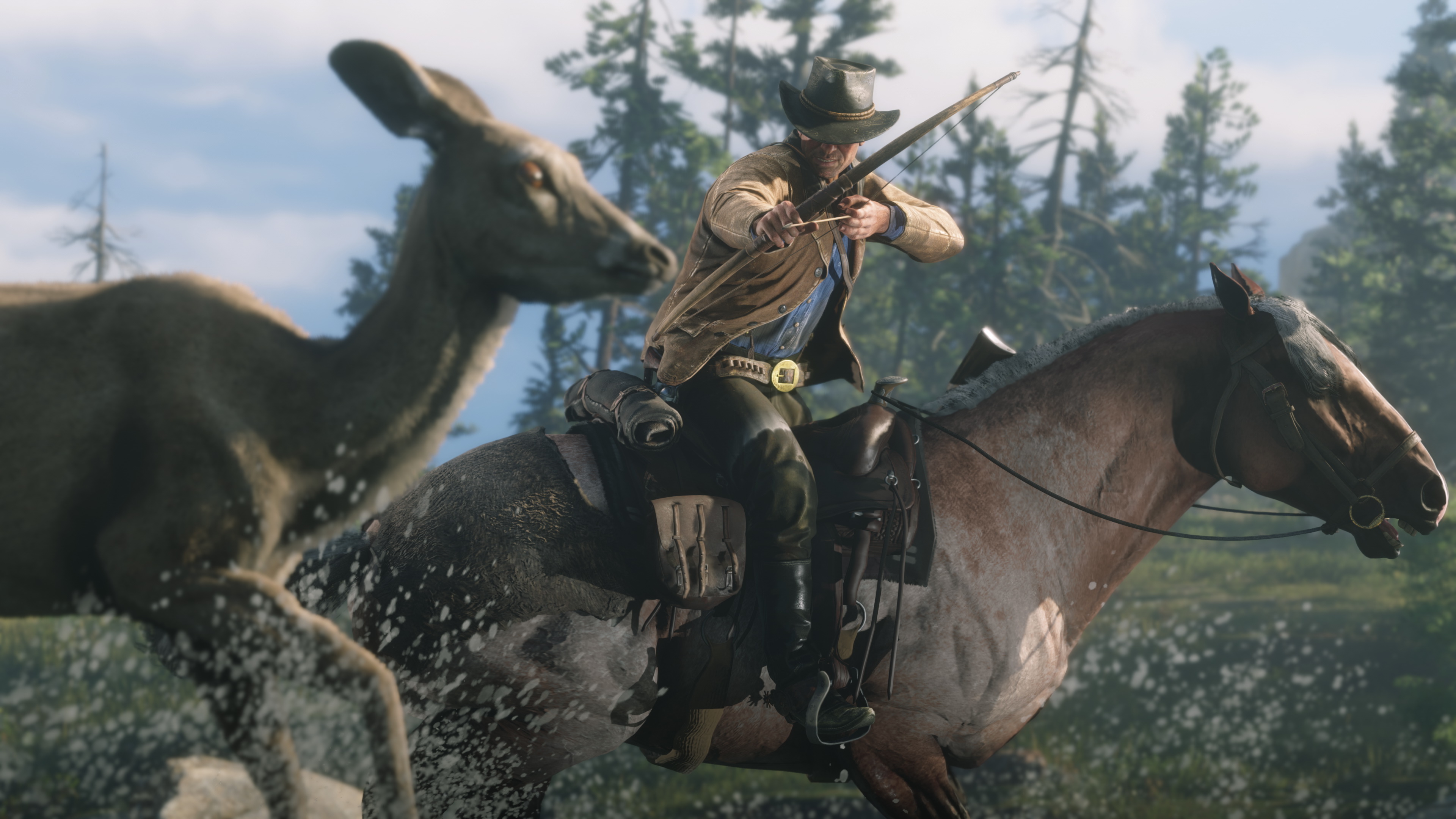
Arthur Morgan was not a real person, yet, his untimely death still saddens me. I was shocked to feel such a loss over a (stupid) video game character. I felt like I lost a close friend. I also felt a little silly wanting to spend more time with Arthur after learning that his death was imminent.

I should probably start explaining.

A STUPID VIDEO GAME

My teenage son turned me on to the game “Red Dead Redemption 2” (RDR2 as the kids call it) one weekend the Summer “Lockdown” of 2020. I noticed that he was coming out of his room less for snacks and drink re-fills. I knocked on his door in search of proof of life. Instead of finding him bouncing up and down, engaged with his friends, yelling into his headset while playing some soldier game or NBA 2K20 — he was quietly sitting at the edge of his bed. His attention was intently focused on what looked like a scene from an old Clint Eastwood western movie. “Son, ” I asked, “what are you doing?” His concentration was solid; he didn’t move when I spoke. “I’m trying to find the Legendary Buck, Dad,” he replied in a hypnotic trance. That’s when I sat down to watch a few minutes of gameplay.

According to Wikipedia: Red Dead Redemption 2 is a 2018 action-adventure game that has sold 44 million copies to date. The story is set in 1899 and follows the exploits of outlaw Arthur Morgan, a member of the Van der Linde gang, in a fictionalized representation of the Western, Midwestern, and Southern United States.

Gamers and critics have both praised the game for its open world game play, where players can invest over 60-hours in the game’s storyline and still continue to find exciting side missions, new characters, and unique bonus content. With majestic images of snow covered mountains, dusty, Old West towns, the spirit of the City of New Orleans, this game also emerges the player with a dynamic music score and authentic character voices.

That summer, instead of sitting on the couch for another “thanks, COVID”, binge session of a Netflix series that I would never get past the first episode of, my wife would make “that” face as I slipped away to play this game in my son’s room. RDR is addictive because it’s so immersive; it feels REAL. You begin to act like you are living through this character – not controlling him. You make decisions that will affect his storyline, yet, you don’t pay the consequence for his bad choices. If you were a fan of the first season of “Westworld” on HBO or the book (and movie) from Michael Crieghton, this game’s morality component will capture your attention. Then there are the graphics and sound production. You can actually see the wind blow through the trees. My dog comes in the room when she hears a distant gray wolf howl. Every detail is painstakingly accurate, even down to the historical references and connections.

Get ready for the Masonic connection because it’s coming

Not to spoil your interest in the game, but what turned me from a casual player to die-hard fanatic — the kind of guy who still watches RDR2 YouTube videos on his lunch break — was the plot twist in Act 2. This occurs in the fictional town of Saint Denis, representing New Orleans, where Arthur passes out in the street. It’s a pretty scary experience because you “control” him during a coughing fit, leading up to him dropping unconscious in the street. Cut to a scene in the doctor’s office where you are diagnosed with tuberculosis (“consumption”) and are told to move somewhere dry and warm. Tuberculosis (TB) was the leading cause of death in the 1800s as no medicine existed for treatment. Penicillin wasn’t discovered until 1928, leaving patients around the turn of the century with a disease that caused massive weight loss, a nasty cough that led to hacking up fluids, and certain death.

This news is saddening on many levels! First, the diagnosis scene is nothing like you will find in any other video game. The emotions are a real break in the storyline; something would experience in a movie or book — not a (stupid) video game. Second, watching Arthur stagger out of the doctor’s office left with memories of close friends and loved ones have said to him over the years as he contemplates his life is moving. Finally, this event takes place after you have invested a good 60 hours of gameplay; it totally knocks the air out of your sails. “Are you kidding me? He’s going to DIE!” I wanted to yell out loud.

inspired vision to enable us to look with faith beyond the veil

One evening, I was sitting at dinner with my wife, who coyly asked, “are you going to play your (stupid) game again tonight?” It was embarrassing to admit, but I looked at her and calmly replied, “I just want to spend some time with Arthur tonight.” I then gave her the Reader’s Digest version of what the plot line I shared with you. She wasn’t impressed. As my gaze fell to my empty dinner plate, a second thought came to mind. “Ryan was right,” I said out of nowhere. My wife’s look is probably similar to yours right now, Dear Reader. If you feel like you missed something, you haven’t.

My Masonic Brother Ryan, had invited me over to his house for a social-distanced Memorial Day gathering. Nothing says “Summer 2020” like celebrating with hamburgers, hot dogs, and beers in lawn chairs six-feet apart. During our conversation on our feelings for Freemasonry, Ryan shared his belief that “Freemasonry can found anywhere, and in everything, you can find Freemasonry.” Okay, I gave him more line instead of reeling him in. I asked, “like esoterically?” “It can be, but my point is much simpler than that,” he continued. “Say you are into video games, sports, or whatever. There has to be something in that, that can relate to Masonry.” To me, his point brilliantly summarized the lesson in the EA degree on dividing one’s time. Not in allotting our time schedule, rather managing our time to include moments for personal growth and reflection. Ryan honed in on how this connects to our hobbies and interests. “If something brings joy in your life, you can relate that to Freemasonry.”

And That’s When He Got Me

Ask anyone who has played RDR if they played the game differently KNOWING that there was a real chance Arthur wouldn’t make it until the end of the game… and I will point to a group of men pursuing the virtues of a legendary Master Mason during the building of King Solomon’s Temple. Sometimes, our hero doesn’t make it to the end of the story and it falls to his Brothers to continue his work.

Bro. Michael Arce Co-Founder, Craftsmen Online Mt. Vernon #3, Albany, New York St. John’s #11, Washington, DC
Freemasonry’s Missing Rings: Thaddeus Kosciuszko

Freemasonry’s Missing Rings: Thaddeus Kosciuszko

Freemasonry’s Missing Rings: Thaddeus Kosciuszko

How did this Revolutionary War hero escape membership into The Craft?

When you travel north to Saratoga Springs, Lake George, Fort Ticonderoga, or the Adirondack Mountains in Upstate New York, you will cross over the “Twin Bridges,” as the locals call them. From my broadcasting days, “The Twins” were much easier to say during traffic reports than the Thaddeus Kosciusko Bridge. However, what makes the bridge unique, aside from the Polish name, is its design: two identical steel arched bridges, with decks that span across the Mohawk River. Technically, crossing the Twin Bridges to and from work would have been my introduction to Kosciuszko.
Hero of the Revolutionary War. Military Leader of Poland. A Close Friend of America’s First Freemasons. How was Thaddeus Kosciuszko never made a Mason?

WHO WAS KOSCIUSKZO

The first time I heard the name Thaddeus Kosciuszko was when I was talking about Revolutionary War history with a co-worker. She was raving about the documentary “Kosciuszko: A Man Before His Time.” As she shared it, his story was one worth learning about; born into a Polish noble family, Kosciuszko would eventually leave Poland to join the American patriots in the Revolutionary War, return to Poland and lead his own people in their fight for Independence. I was compelled to learn more about this man who George Washington trusted to build and fortify West Point. In his book, “The Peasant Prince: Thaddeus Kosciuszko and the Age of Revolution,” Alex Storozynski brilliantly details the life and time of Kosciuszko. You learn of a young man who, after being schooled in architecture, drawing (fine art), and military strategy, leaves Poland to join the fight on the side of the Americans during the Revolutionary War. Let me take a second to note some of Kosciuszko’s military accomplishments. He protected the banks of the Delaware River, preventing the British from invading Philadelphia.

When his idea of building an attack position above Fort Ticonderoga was ignored, Kosciuszko saved the Continental army engineered a solution to slow the British Army, allowing the Americans to escape across the Hudson River. During the second Battle of Saratoga, he planned a robust array of natural defenses, using ledges, rock formations, and the terrain as cover – frustrating the British while positioning his men to victory.

Kosciuszko’s travels put him in direct contact with known Freemasons: Benjamin Franklin, Nathanael Greene, Marquis de Lafayette, and George Washington.

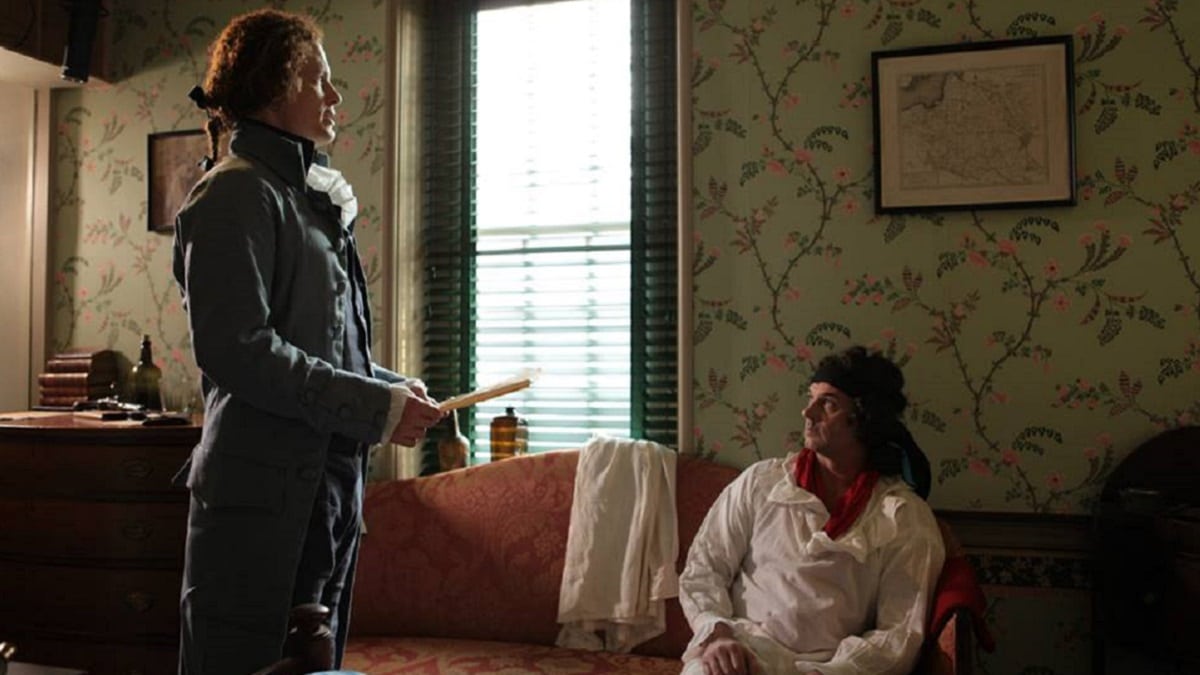
Pictured: (L-R): A re-enactment of Thomas Jefferson and Thaddeus Kosciuszko meeting.

Kosciuszko lived and served with these essential men in a time when the ideas of democracy, freedom, and independence were the favorite topics of discussion. George Washington hung Kosciuszko’s portrait in his home, and his friend Thomas Jefferson wrote that “He is as pure a son of liberty as I have ever known.”

The Case For A Missing Freemason

Thaddeus Kosciuszko possessed the two Masonic principles that we are charged to embrace: Fidelity and Integrity. There are several examples in the book of opportunities during the beginning of his Revolutionary military service where General Kosciuszko could have risen in rank faster or received more pay IF he stepped on others to advance himself. Instead, he took promotions as he earned them and served for seven years without collecting a salary. His concerns were always for the care and comforts of his soldiers, who he regularly wrote to Congress and General Washington for new boots, clothing, or weapons. When I finished the book, I reached out to the author Alex Storozynski to investigate if Kosciuszko was a Mason. I couldn’t see how a man of his age who was in the company of Washington, Franklin, and many other historical Masons of that era would not have attended a Lodge or somehow escaped being a member of one.

I also contacted Kosciuszko Lodge No. 1085, the first Lodge composed of men of Polish and Slavic descent in the United States of America, which meets in the Grand Lodge of New York, to see if they had any supporting documents. I wasn’t the first to ask the question. “I wish he were a Mason,” stated Storozynski when we spoke. “If I had found anything, I would have surely included it in my book!” Alex and I spent the time discussing how, after the connections with Franklin, Lafayette, and Washington – considering how life was much different than now, their time huddled closely during winter or the lavish parties they would attend in each other’s honor, how was it possible that the subject of Freemasonry never came up?

The Search for a Missing Masonic Ring

Both Kosciuszko and Washington were members of the Society of Cincinnati. We also couldn’t fathom how, after being released from prison for leading an uprising against Catherine the Great, Kosciuszko didn’t petition a Masonic lodge in Europe when he was close friends with Thomas Jefferson. Jefferson was known to have attended meetings at the prestigious Lodge of Nine Muses in Paris, France. (For a more detailed look into whether Jefferson was a Mason, click here) If Kosciuszko wasn’t an American Freemason, was it possible that he could have petitioned a Lodge in Europe? Again, the answer is no. Although if you search the Grand Orient of Poland online, they list Tadeusz Kościuszko as a “Predecessors in the Craft.” But as far as official documentation that states Kosciuszko was made a Mason at a certain time and place, for now, that search comes up empty.

Bro. Michael Arce
Co-Founder, Craftsmen Online
Mt. Vernon #3, Albany, New York
St. John’s #11, Washington, DC