1867 to Eternity: Hugh Barkley Bull and the Beginnings of Wallkill Lodge 627

1867 to Eternity: Hugh Barkley Bull and the Beginnings of Wallkill Lodge 627

MASONIC HISTORY

1867 to Eternity: Hugh Barkley Bull
and the Beginnings of Wallkill Lodge 627

Earlier this year, I noticed the gravesite monument of W. Bro. Hugh Barkley Bull, located in the Brick Church Cemetery in Montgomery, New York, had fallen into severe disrepair. I had taken it upon myself, as Worshipful Master and Historian of Wallkill Lodge 627, to rally the brethren for a stone-cleaning workshop. Because W. Bro. Bull was initiated, passed, and raised in Goshen Lodge 365, I invited the Goshen brethren, through Worshipful Master Erik Geehern, to collaborate with us on this heartfelt mission. After personally funding all necessary equipment, I scheduled Saturday, July 20, 2024—honoring the 155th year of W. Bull’s passing—for the arduous project.

Few men or Masons ever reach the inconceivable heights of profound distinction. For many, their records, merits, and achievements vanish into history. One such Mason, who was revered and remembered for a life of selfless service, but whose memory is all but lost, is Brother Hugh Barkley Bull. He embodied endless faith in God and devoted selfless service to community; it was said upon his passing that he was “a useful and esteemed citizen” whose “life was distinguished by great usefulness.”

His story begins October 7, 1816, in Crawford, Orange County, New York. His mother was Maria Barkley; his father, David C. Bull, was a descendent of the iconic William Bull, an English immigrant and operative stonemason who built Knox Headquarters, which at one time was used by generals Nathaniel Greene and Horatio Gates during the American Revolution.

Hugh Bull grew up on a well-cultivated, 1,000-acre farm near Bullville, New York. Dozens of workers from nearby villages worked on the many farms, creameries, and distilleries about the hamlet which bears the Bull family name. Bull was afforded many comforts during his childhood, owing to his family’s prosperous stature.

After completing his early education at the local prep school Montgomery Academy, Bull entered the prestigious halls of Union College in Schenectady. Founded on the motto Sous les lois de Minerve nous devenons tous frères (Under the laws of Minerva we all become brothers), Bull immediately was enamored with the deeper meanings in education and he was active in many social circles. He was a member of Phi Beta Kappa, was active in the pipe and song Kappa Alpha fraternity, and was a loyal member of the literary Philomathean Society. Bull also sat on the reputable Senate Committee which, in 1841, welcomed distinguished speaker Benjamin Butler who, twenty years later, would serve as a major general in the Civil War, and then governor of Massachusetts in 1888. Also in 1841, Bull and his class of ’80 graduated from Union College. Many would become accomplished physicians, clergymen, teachers, and lawyers. Bull pursued the latter, and upon removing to Goshen, he began studying law under the Hon. Samuel J. Wilkin, late congressman. After being admitted to the New York State Bar, Bull practiced law in Montgomery, New York.

By 1847, Hugh Bull was an Orange County district attorney and, for many years, served as justice of the peace. During this time, he grew a reputation as a tremendous public speaker, and was known to be thorough in all his vocations. Bull grew so popular in many social circles that in 1851, he was elected to the State Assembly. Although his stint in Albany was only one year, he was active with legislation that supported his Orange County district, including bills concerning banking, insurance, securities, and infrastructure.

Upon his return to Goshen, Bull was met with great accolades and fandom. In 1855, he was requested to speak in Montgomery on the history of the late Orange Hussars who, in 1793, served as the hamlet’s local militia. The following year, he was invited to speak before the Orange County Educational Society, where he praised the importance of teachers, and the significant duties that rest upon them.

He served as the recording secretary of the New York State Agricultural Society in 1859; was president of the Orange County Bible Society; and was secretary and counselor of the Montgomery & Erie Railroad.

In 1866, Bull petitioned for the mysteries of Freemasonry at Goshen Lodge 365, and was initiated during the lodge’s 210th communication on June 18 which drew visitors from Port Jervis, Warwick, Hiram, and Hoffman lodges. Bro. Bull was passed to the Degree of Fellow Craft on the following July 2, and was raised to the Sublime Degree of Master Mason two weeks later, becoming the 114th member of Goshen Lodge at the age of 49.

With his law office ten miles away in Montgomery, and with his zeal for the fraternity, Bro. Bull approached the Grand Lodge of the State of New York to begin the process of forming a new lodge. On October 10, 1866, Most Worshipful Robert D. Holmes, Grand Master, granted dispensation to the fledgling lodge. A week later, the town of Montgomery was chosen to be its location, and the name Wallkill was selected, chosen mainly because the Wallkill River’s strong current provided employment to thousands in grist mills, factories, and agriculture.

On December 7, five Master Masons, donning white gloves, jewels, and white leather aprons, assembled for Wallkill Lodge’s first regular communication. Those in attendance were:

Worshipful Master Hugh Barkley Bull, raised in Goshen Lodge 365; Senior Warden Constant W. Wadsworth, raised in Hiram Lodge 144; and Junior Warden Robert Young, raised in Columbia Lodge 38. Brothers Henry H. Hallet (Pyatt Lodge 194) and William J. Welsh (Hancock Lodge 552) also were entered onto the rolls.

The first order of business was appointing officers: Constant W. Wadsworth, Treasurer; William J. Welsh, Secretary; Henry H. Hallet, Senior Deacon; Henry H. McElhenny, Junior Deacon; Sidney D. King, Senior Master of Ceremony; Robert Brown, Jr., Junior Master of Ceremony; and Samuel N. Sands, Tiler.

Afterward, a motion was proposed to adopt the by-laws of Goshen Lodge 365 with a few alterations establishing dues at three dollars per year; remunerating the Tiler at one dollar per meeting; and scheduling Regular Communications weekly on Friday evenings.

Eight petitions were read at the first meeting, all proposed and recommended by Bro. Wadsworth. The lodge was then closed in Due and Ancient Form on the Third Degree of Masonry.

The following week, there was confusion in the Craft during the second Regular Communication, testing W. Bro. Bull. During frigid temperatures with five inches of snow accumulated, it was entered in the minutes that “a rascal, commonly called ‘Jack Frost,’” entered the lodge room without permission from the Master, but without proper heating, was allowed to remain under protest for the duration of the meeting.

Wallkill Lodge would confer the Entered Apprentice Degree five times before hosting its first Fellow Craft Degree on February 1, 1867. W. Bull, still a new Worshipful Master, had met some obstacles early on and was a little behind in ritual proficiency. With great regret, he stepped aside and allowed W. Bro. David A. Scott, Master of Hudson River Lodge 309, to confer the degree. Later that night, they would raise four Brothers to the Sublime Degree. The first to be entered onto the rolls of Wallkill Lodge were Theron M. Little (teacher), Daniel C. Carvey (merchant), Gardiner S. Graham (farmer), and Allen Mead (tobacconist). Those who would follow them came from all concerns and employments, including politicians, lawyers, wagon & harness makers, farmers, physicians, firemen, and police officers, among others.

On St. John the Baptist Day 1867, Wallkill Lodge received its charter and was issued number 627. The document was signed by Most Worshipful Stephen H. Johnson, Grand Master, and attested under the seal of Grand Lodge. Right Worshipful Landon S. Straw, District Deputy Grand Master of the Orange, Rockland and Sullivan Masonic District, noted earlier in his official report to Grand Lodge: “I have visited Wallkill Lodge, working under a dispensation, and found them in possession of the Standard Work, and being satisfied their aim is the highest, I cordially and cheerfully recommend that a warrant be granted to them.” This was an iconic and historic moment, full of jubilee for W. Bull and brethren of Wallkill Lodge. The Secretary proudly wrote on the first page of the new visitor book: “1867 to eternity.”

Bull would serve two more years as Master, however, on June 15, 1869, he would preside in the East for the 53rd Regular Communication to confer the Entered Apprentice Degree, but this would be his final meeting.

The following month, after delivering an eloquent and patriotic Fourth of July address, Bull fell ill with extreme bouts of diarrhea, stomach pain, and mind-numbing fevers. He was removed to Port Jervis to recover.

W. Hugh Barkley Bull laid down his Working Tools July 10, 1869 due to typhoid fever. He left behind his loving wife Hannah Jane Decker Bull and fifteen-year-old daughter Maria. Bull was a devout Christian and an elder of Montgomery Presbyterian Church. When news of his passing spread far and wide, members of the local community were utterly devastated.

Two days later, Wallkill Lodge opened a Special Communication where District Deputy Grand Master G. Fred Wiltsie presided. The meeting was short. The lodge was opened on the Third Degree and closed soon thereafter, allowing the brethren to travel by horse and carriage to the home of deceased. After a mournful funeral service, the brethren proceeded to march in a grand procession, escorting the remains of their dear brother to his final resting place. Bull was interred and laid to rest at the Brick Church Cemetery in Montgomery, where that towering 15-foot white granite obelisk stands, marking his eternal honor and legacy.

On August 3, 1869, Wallkill Lodge, under Bro. Henry H. Hallet, acting-Worshipful Master, passed the following resolution:

To the Worshipful Master, Wardens and Brethren of Wallkill Lodge No. 627 F.&A.M.

Whereas: It hath pleased the Supreme Architect of the Universe to remove from our midst our Brother H.B. Bull, the WM of this Lodge thereby severing another link in the fraternal chain be it

Resolved 1st: That we the Brethren of Wallkill Lodge No. 627 F.&A.M. in our associate capacity deeply deplore the loss we have sustained in his removal from our band. 

Resolved 2nd: That we make this public acknowledgement of our appreciation of his excellent character as a man and Brother Mason and that his sudden removal should be a warning to each one of us and serve to teach us to be prepared to meet in the Grand Lodge above.

Resolved 3rd: That we sincerely mourn with the widow and fatherless in this, their hour of desolation and sorrow, and extend them our heartfelt sympathy and commend them to the care of God, who doeth all things well.

Resolved 4th: That a copy of these resolutions be handed to the family of our deceased Brother and that they be entered in full upon the minutes of the Lodge and also published.

Hugh Barkley Bull was a noble man, full of sound moral principles. He governed his life through the beacon of faith and for his love of the Craft. In 2019, a watercolor painting was privately commissioned and donated to the lodge. Today, it is proudly displayed in the East behind the Secretary’s desk.

That graveside monument restoration on July 20 kicked off at 9 a.m. with a brief talk on the life of Hugh Barkley Bull. Immediately following, I provided thorough instruction on stone-cleaning. Then we began. Approximately ten brothers between both lodges, employing two ladders, ten gallons of water, five gallons of D/2 Biological Solution, numerous soft bristle brushes, and various other cleaning equipment, completed the work by early afternoon.

It was a shining moment for the Orange-Rockland-Sullivan Masonic District as two lodges united to honor a pillar of our shared Masonic history.

Bibliography

Butler, B. F., An Address Delivered Before the Senate of Union College on the 26th July, 1841. C. Van. Benthuysen, 1841.

Catalogue of the Members of the Philomathean Society, Instituted in Union College, 1795, J. & W.H. Riggs, 1847.

A Catalogue of the New-York Alpha of the Phi Beta Kappa; Union College, Riggs, 1852.

Catalogue of the Officers and Students in Union College, 1841, Riggs, 1841.

Davies, H. E., A Compilation of the Laws of the State of New York, Relating Particularly to the City of New York. Banks, Gould & Co., 1855.

Death of Hugh B. Bull, Evening Gazette, July 13, 1869.

Hugh B. Bull, New York Herald, July 15, 1869.

Meeting Minutes, Goshen Lodge No. 365 F. & A.M., Archives.

Meeting Minutes, Wallkill Lodge No. 627 F. & A.M., Archives.

New York Alpha of the Phi Beta Kappa Union College, 1922.

New York State Register, 1847; Being a Supplement to the Register for 1845-6, J. Disturnell, 1847.

A Record of the Members of the Kappa Alpha Fraternity and a City and Town Directory, A.H. Kellogg, 1892.

Ruttenber, E., History of the Town of Newburgh. E.M. Ruttenber & Co., 1857.

Ruttenber, E., & Clark, L., History of Orange County New York, Everts & Peck, 1881.

Transactions of the Most Worshipful Grand Lodge of the Ancient and Honorable Fraternity of Free and Accepted Masons of The State of New York, Holman, 1864.

Wilder, A., The New York Teacher: A Monthly Periodical, Devoted to The Cause of General Education and to the Elevation of the Teachers Profession (4th ed.), James Cruikshank, Publishing Agent, undated.

By W. Bro. Kyle A. Williams

Bro. Williams, a collector of New York Masonic history, is Worshipful Master of Wallkill Lodge 627 in Walden, New York, where he also is lodge Historian.

Samuel Lloyd Kinsey

Strengthening the Masonic Fraternity

Strengthening the Masonic Fraternity

EDITORIAL

Strengthening the Masonic Fraternity

IDEAS ON HOW TO INCREASE THE VISIBILITY OF YOUR LODGE IN THE COMMUNITY

The purpose of our Masonic Fraternity has always been “to make some good men, better.” Freemasonry encourages its members to improve themselves and to establish strong links among each other. In addition, some of these better men have felt a call to improve their communities, making Freemasonry a valuable asset for society. However, this important aspect doesn’t seem to be well understood by some. In this article we examine this situation further.

Let’s consider three fundamental factors: (1) the state of our contemporary society, (2) the nature of our Institution, and (3) the different types of Freemasons.

First, contemporary society has ceased to be as gregarious as it used to be. Computers, cell phones, and other such media devices foster individuality. As a result, most organizations, professional societies, churches, unions and clubs, have seen their membership decline.

The second factor is the nature of our Institution. Organizations acquire an unwritten contract with its members, to make good use of their time and resources. After we raise a Brother, do we provide further masonic education, substantial fellowship events, or further involvement in community work? Attending Lodge to discuss budget issues does not raise much interest. Providing lectures or training on useful topics (e.g., internet, computers, software) will help Brethren succeed in the profane world.

The third factor is the type of member, as not everyone is the same, likes the same things, or has joined our Craft for the same reasons. For example, some join in search of fellowship; and find it in our meetings and social activities. Others join to acquire esoteric experiences, and they find it in our Observant and Research Lodges. Still others, join to improve themselves -and some of these, may also want to help improve society at large.

One way to increase our visibility is by developing community projects. Grand Lodge has several national projects such as the Masonic Medical Research Lab. But Freemasonry, like politics, is Local. Our community needs to know what we are doing for them: developing a food pantry; providing Thanksgiving and Christmas meals; Breakfast with Santa; Easter egg-hunts; a career day for high school kids; building ramps for the disabled, etc. These few examples of projects give the Craft more visibility in our communities. They do not cost much, but require work, which can also help increase Lodge fellowship and participation.

We can also open our Lodges for selected activities, inviting friends and neighbors to participate and see what we do. It is sometimes difficult to explain that we are not a secret, but a discrete organization. A better way is by having people visit our Lodges.

Lodges can organize public activities, such as documentaries about travel, especially during our long winters. Lodges can develop presentations about identifying drug problems, or potential health issues, and about ways to resolve community problems. We have Brothers with many backgrounds, that allow them to address these issues.

Most Lodges have a multipurpose room, where social events can be prepared, using a projector, computer, sound system, etc. A District-wide lists of lecturers can be established to find speakers. Offer coffee and donuts. Some topics may have been already presented elsewhere. But our neighbors may prefer to hear a speaker they know, and can relate to.

After the presentations, invite the audience to visit the Lodge room, and have a Brother answer questions. Advertise events in the local newspaper and radio stations. Join forces with other local organizations: Rotary, Lyons, VFW, the library, etc. and with other local Lodges.

Finally, work with DeMolay, Rainbow Girls and other youth groups. Provide them with interesting activities such as camping, canoeing, bowling, as well as training in practical things (computers, exam reviews, etc.). They will grow up and eventually join …
Such things help members develop an increased and stronger Lodge involvement. People usually respond positively to groups activities. Project work creates stronger fellowship bonds.

The Craft will attain higher visibility in our own communities. Friends and neighbors will have a different outlook of who we are, and what we do. Community work may become the best promotion of our Craft, and an efficient recruiting tool. For, some of these neighbors and friends, participating in our activities, may want to know more about us, and eventually join the Craft.

Planning, preparing and carrying out of such activities and projects will take extra time and energy, from our Lodge members. But such activities will also contribute to retain them. Some other Masonic writers have proposed radical changes to our Craft, that reminds me of the saying “you are throwing away the baby with the bath water”. Maybe, losing members will help us think through all these issues, and come up with efficient answers.

Written by Bro. Jorge Luis Romeu. WB Romeu is Past Master of Liverpool Syracuse Lodge #501, dual member of the Grand Lodge of Puerto Rico, and a 32nd Degree Scottish Rite mason. He is Membership Chair of the Onondaga District and a member of the GLONY Retention Training Program.

The Pride of the Fraternity

The Pride of the Fraternity

MASONIC HISTORY

The Pride of the Fraternity

“A distressed, worthy brother and his widow must be comforted and guarded so long as the obligation, which makes us Masons, is cherished and remembered.”

Photo: Masonic Home of Utica

M.W. James Ten Eyck, Grand Master, bellowed those eloquent words on June 7, 1892, during the Grand Lodge of New York’s Annual Communication, and went on to regard the new Masonic Home of Utica as “the Pride of the Fraternity.”

Nearly 181 years ago, the Grand Lodge of the State of New York began the illustrious and monumental project of erecting a home for ailing Masons, their widows, and orphans. In 1842, a building fund was started, with a $1 subscription, and paid at the time by Grand Tiler Greenfield Pote, after the project had been commented on by Grand Secretary James Herring. This dream finally became a reality a year later, on June 8, 1843, when 100 Masons signed a petition for the purpose of founding the asylum.

Committees were formed and, by 1851, a recommendation was made to purchase property in Utica because it was located in the “center of the state,” and would be most central for New York Masons. The site was to be placed on “Utica driving park,” which had been used for State Fairs, and sprawled across 230 acres.

Several audacious fundraisers were launched, specifically in 1887, led by the Ladies Masonic Fair Association. The event held in New York City netted $76,000 and helped contribute to the estimated $175,000 needed to begin building the site. Grand Lodge added a $3 per capita assessment in 1889 to help meet the financial needs for the Masonic Home.

On May 21, 1891, the cornerstone, which was hewn of Quincy granite and weighed 1,750 pounds, was laid by M.W. John W. Vrooman, Grand Master, who wielded a magnificent silver trowel during the compelling ceremonies, as brass bands afterward serenaded throngs of spectators, including 6,734 Masons.

Renaissance architecture was chosen for the design, and the material used consisted of quarry-faced stone, with trimmings of brownstone, and Philadelphia front brick for the upper stories. The woodwork was of oak, ash, and white pine. The main center building was for the administrative offices, while the wings were devoted to rooms for patients. The basement contained two large swimming pools, playrooms for children, and dormitories for the workers. The first story had offices, and staterooms, and the second story provided additional dormitories for resident staff, and children. The third floor offered lavish offices and common rooms, and the fourth story was used as an infirmary, subdivided into five rooms for men, women, boys, girls, and nurses.

The City of Utica graciously contributed $30,000 toward the project, and the cost of the home upon completion was roughly $182,000.

On October 5, 1892, the Masonic Home was dedicated by M.W. Ten Eyck and the site officially was opened. “The doors of the home [have] swung wide with true Masonic hospitality to the Brethren of the Craft and their widows, who have needed a friendly and kindly environment in which to wait for life’s sunset, and to the orphans, who in youth needed the protection of affection and incentive for high living and true citizenship,” exclaimed Ten Eyck. “[May] God grant never to close as long as the human heart beats in sympathy with our Brothers’ woes.” Upwards of 8,524 Masons, donning the white lambskin, proudly marched six miles for a grand parade from Bagg’s Hotel to the new Masonic Home. Dignitaries were on horseback, others in carriages, and George Washington’s Bible illuminated the large procession.

On October 5, 1892, the Masonic Home was dedicated by M.W. Ten Eyck and the site officially was opened. “The doors of the home [have] swung wide with true Masonic hospitality to the Brethren of the Craft and their widows, who have needed a friendly and kindly environment in which to wait for life’s sunset, and to the orphans, who in youth needed the protection of affection and incentive for high living and true citizenship,” exclaimed Ten Eyck. “[May] God grant never to close as long as the human heart beats in sympathy with our Brothers’ woes.” Upwards of 8,524 Masons, donning the white lambskin, proudly marched six miles for a grand parade from Bagg’s Hotel to the new Masonic Home. Dignitaries were on horseback, others in carriages, and George Washington’s Bible illuminated the large procession.

The following year, M.W. Jesse B. Anthony, Past Grand Master, was installed as Superintendent, and the first Mason to be received as a resident was Brother James Borden of Greenwich Lodge 467.

During its early years, the Masonic Home offered large rooms that accommodated from two to six people each. The area also featured impressive reading rooms, a billiard hall, a smoking and lounging room, a sun parlor, and an on-site hospital. The site also included a school for kindergarten through fifth grade, and offered a playground and other amenities for children.

From 1892 to 1911, the site cared for 191 children, 892 adults, and operated with a staff of seventy. Rising hour was 6:30 a.m., and lights out was 10 p.m.

Today, the Masonic Home is named the Masonic Care Community, and is a first-class facility that serves 500 people on a majestic 400-acre campus. The mission continues to “support, nurture, and educate” those in need. The center does this by “providing exceptional care and services with compassion and pride guided by the Masonic Principles of brotherly love, relief, truth, and integrity.”

Interesting Facts: 

  • The site at one time bolstered an impressive farm: 104 cows, seventy-five pigs, sixty sheep, and plenty of chickens.
  • At least twenty-three boys who grew up at the Masonic Home valiantly served their country during World War I. Three were wounded in battle.
  • During the early 1920s, the cost of maintenance averaged $200,000 annually.
  • The Masonic Home once used more than 3,000 tons of coal a year.
  • Fifty barrels of flour were once used per month.
  • Upwards of 25,000 visitors came every year.

Sources: 

Lang, O., History of Freemasonry in the State of New York, Grand Lodge of New York, 1922.

Greene, N., History of the Mohawk Valley: Gateway to the West 1614-1925, New York State Masonic Home at Utica, 1925.

Proceedings of the Grand Lodge of Free and Accepted Masons of the State of New York, 1892.

The Illustrated American, June 13, 1891.

The Masonic Home, The Trustees of the Masonic Home and Asylum Fund, 1911.

By W. Bro. Kyle A. Williams

Bro. Williams, a collector of New York Masonic history, is Worshipful Master of Wallkill Lodge 627 in Walden, New York, where he also is lodge Historian.

Samuel Lloyd Kinsey

A Stinging Reminder of the Virtue of Industry

A Stinging Reminder of the Virtue of Industry

MASONIC LIFE

A Stinging Reminder of the Virtue of Industry

Cultures around the world and across eons have recognized the sacred nature of the honeybee. To the Cherokee, the bee represents the reward of patience, and its sting is the penalty for greed. The Celts and the Greeks alike believed bees had supernatural powers and that they could travel between worlds. The Bible mentions honey numerous times, always relating to purity or plenty. In Freemasonry, the Beehive represents the work of the Master Mason and the industry of our lodges, as it inculcates team work and dedication as means toward shared security and prosperity.

A recent incident, as I was being installed as Senior Warden of Sigma Council Princes of Jerusalem at the Valley of Schenectady, drew my attention to the industrious nature of the bee and its important message to the brothers of our great fraternity.

Photo: “Valley of Schenectady installation group photo “


It was a warm evening, and Beukendaal Lodge 915’s building was buzzing with brothers and their families who gathered to celebrate the installation. Ill. David E. Barnes lined up the officers according to their line and rank. We walked out and stood at one end of the lodge as the proceedings began. I kept seeing something fluttering around the light above my head, but I ignored it, preoccupied with the importance of this moment to me and my brothers.

I wanted to be a great officer and make my fellow Sublime Princes proud, but my day job all too often makes it hard for me to be as involved as I’d like. In fact, I was exhausted, and my mind drifted back to my long day at work. Suddenly something landed on the back of my neck. I reached back and grabbed it. Ouch! I got stung by a honeybee! I was stunned for a moment, my hand throbbed in pain. I looked at the sting and thought man, what an incredibly bad time to get stung! I was glad I’m not allergic. I turned to the brother to my right and joked about it, saying I hope it wasn’t some sort of omen.

As the evening progressed, I continued to think about the sting. My friend, Paul Meher, Jr., 32° and Deputy Master of Sigma Lodge of Perfection, joked that maybe it followed me home from my work as a pest control service manager. The more I think about it, the more I believe it was a message from the Great Architect reminding me how Freemasons should be industrious, never sitting down while those around us are in need, especially when it is in our power to do so without injury to ourselves.


We must be as loyal as the worker bee is to the hive and its queen. We must impart our knowledge to the Entered Apprentice. If our individual lodges and our great fraternity are to thrive, we must perform our respective and many parts. Whether it be as small as checking on absent brothers, assisting an elder brother climb the stairs, helping to cover lodge expenses, volunteering to clean after an event, or serving as an officer, all labors contribute to a healthy hive for generations to come.

Photo: Bee hive at Masters Lodge 5 in Albany NY

Written by Bro. Russell W. Dickson

Bro. Dickson is the Senior Deacon in St. Patrick’s Lodge 4 and is at labor in Collabergh-Radium 859, both in New York. He is a Royal Arch Mason in Hiram Union Chapter 53, and is a 32° Scottish Rite Mason at the Valley of Schenectady, where he serves as Senior Warden of Sigma Council Princes of Jerusalem. He holds a Bachelor of Arts Degree in journalism from the State University of New York at Albany, and has been a freelance journalist for more than twenty-five years. His work has been published internationally, in multiple languages, by both online and print news outlets.

Samuel Lloyd Kinsey

Friend to Friend Masonic Memorial

Friend to Friend Masonic Memorial

MASONIC HISTORY

FRIEND TO FRIEND MASONIC MEMORIAL

MEET BRO. Ronald F. “Ron” Tunison. The developer of the Friend to Friend Memorial

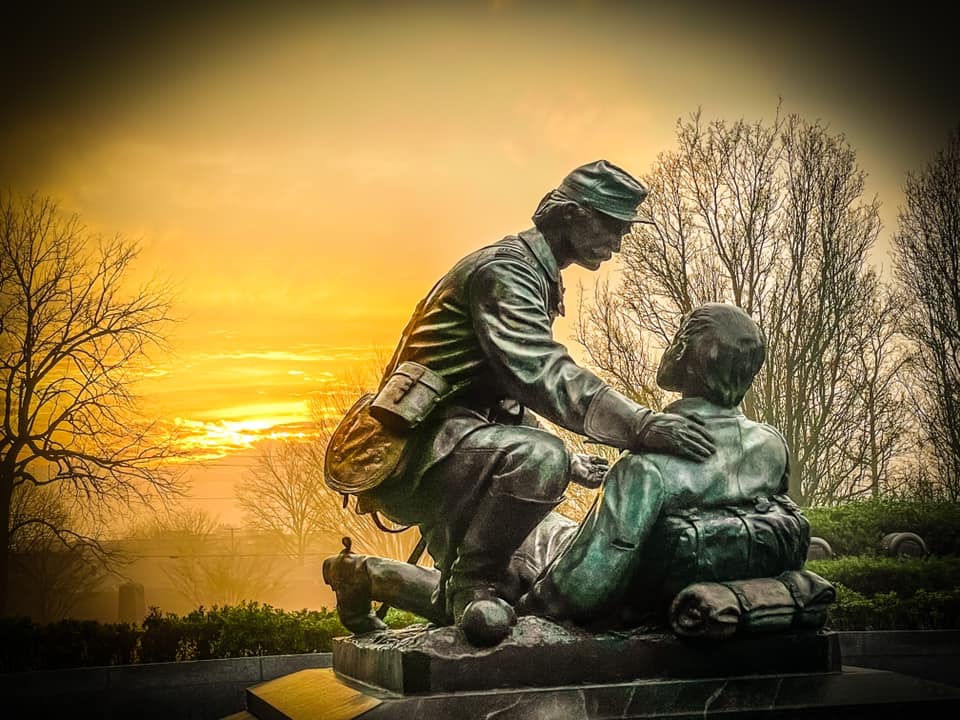
Outside of Independence Day, the first week of July brings another anniversary of the Battle of Gettysburg, the bloodiest single battle of the American Civil War. (Antietam was the deadliest one-day battle in American history). Masons often point to the “Friend to Friend Masonic Memorial” to highlight the strong commitment Masonic brothers have to each other.

Photo: “Friend to Friend Masonic Memorial”

The idea of the memorial was the brainchild of Brother Sheldon Munn, a Brother of Lafayette Lodge No 194 in Pennsylvania and Licensed Battlefield Tour guide and his friend Dr John Schwartz of Good Samaritan Lodge No 336. With over 1,000 memorials on the battlefield, but none about the strong bonds of brotherhood and friendship. They convinced the Grand Lodge of Pennsylvania to work with the National Park Service to jointly develop a memorial at Gettysburg to the Freemasons of the Union and the Confederacy that their unique bonds of friendship which enabled them to remain a brotherhood undivided even as they fought in a divided nation, faithfully supporting their respective governments.

Note: The memorial depicts Union Army Captain Henry H. Bingham assisting the severely wounded Confederate Brigadier General Lewis Armistead after Pickett’s Charge.

A public/private development of such a memorial had never been done. The cemetery Annex was an area the Park Service had long wanted to develop but had not been able to get funding. The Grand Lodge of Pennsylvania agreed to help with the general development of the Annex, and the Friend to Friend Masonic Memorial. The final location was one that was recommended by Jose Aguilar Cisneros, the Superintendent of the Gettysburg National Military Park. The general idea was to show the friendship between Confederate General Lewis Addison Armistead and Union General Winfield Scott Hancock. Since the two had been friends since childhood, but they did not meet on the battlefield, it was suggested that the documented incident of Captain Henry Bingham providing comfort to a dying Armistead shortly after Pickett’s Charge on July 3, 1861, by the park’s historian, Kathleen Harrison.

Bro. Maynard Edwards, 32°, KCCH, details the history behind the “Friend to Friend Memorial.”

The concept was approved at the National Park Service in Washington and noted historical artist Bro. Ron Tunison was selected to develop the monument. At that time, Tunison lived in the Catskills of New York. Tunison was intrigued by the concepts of the fraternity and joined his local lodge, Mountain Lodge No 529 in Windham, New York The Sculpture was cast in the Tallix Foundry, then in Beacon, New York — now part of the Urban Art Projects in Rock Tavern, New York. Sadly, Bro. Tunison passed away in October 2013 at the age of 66.

Photo: Ronald F. “Ron” Tunison, 1946-2013

Besides Friend to Friend Masonic Memorial, Bro. Tunison was an internationally acclaimed sculptor of nine heroic bronze monuments: “General W. Crawford,” near Little Round Top on the Gettysburg, Pennsylvania National Battlefield, the bas-relief “Delaware State Memorial” on Tanneytown Road, and “The Gettysburg Civil War Women’s Memorial” at Evergreen Cemetery. On the Antietam Maryland National Battlefield is Tunison’s “Irish Brigade Monument.” “The Bivouac.” is at the entrance to the Civil War Soldier’s Museum at Pamplin Historical Park near Petersburg, Virginia. “The Delaware Continentals” heroic size bronze monument of three advancing Revolutionary War soldiers stands atop a twenty-five-foot granite pedestal in front of Legislative Hall at Dover, Delaware. At Ringgold Gap in Atlanta, Georgia is Ron’s life-size General Patrick Cleburne statue.
Written by: Bro. Harry Williams Bro. Williams was raised in 1993 and is a member of three symbolic lodges in New York – Geneva-Ark No. 33, Warren No. 32, and Adonai No. 718. He helped to consolidate the Columbia, Dutchess and Greene-Ulster District into the Majestic Mid-Hudson District and bring about a new, revitalized district.
Samuel Lloyd Kinsey